
Packaging & Converting · 2026-11-24
Corrugated Box Gluing: What the Glue Sensor Cannot Tell You
An automated line can record a glue trace while the buyer still lacks evidence for the finished joint. Separate application monitoring from approval of the actual board, surface and adhesive combination.
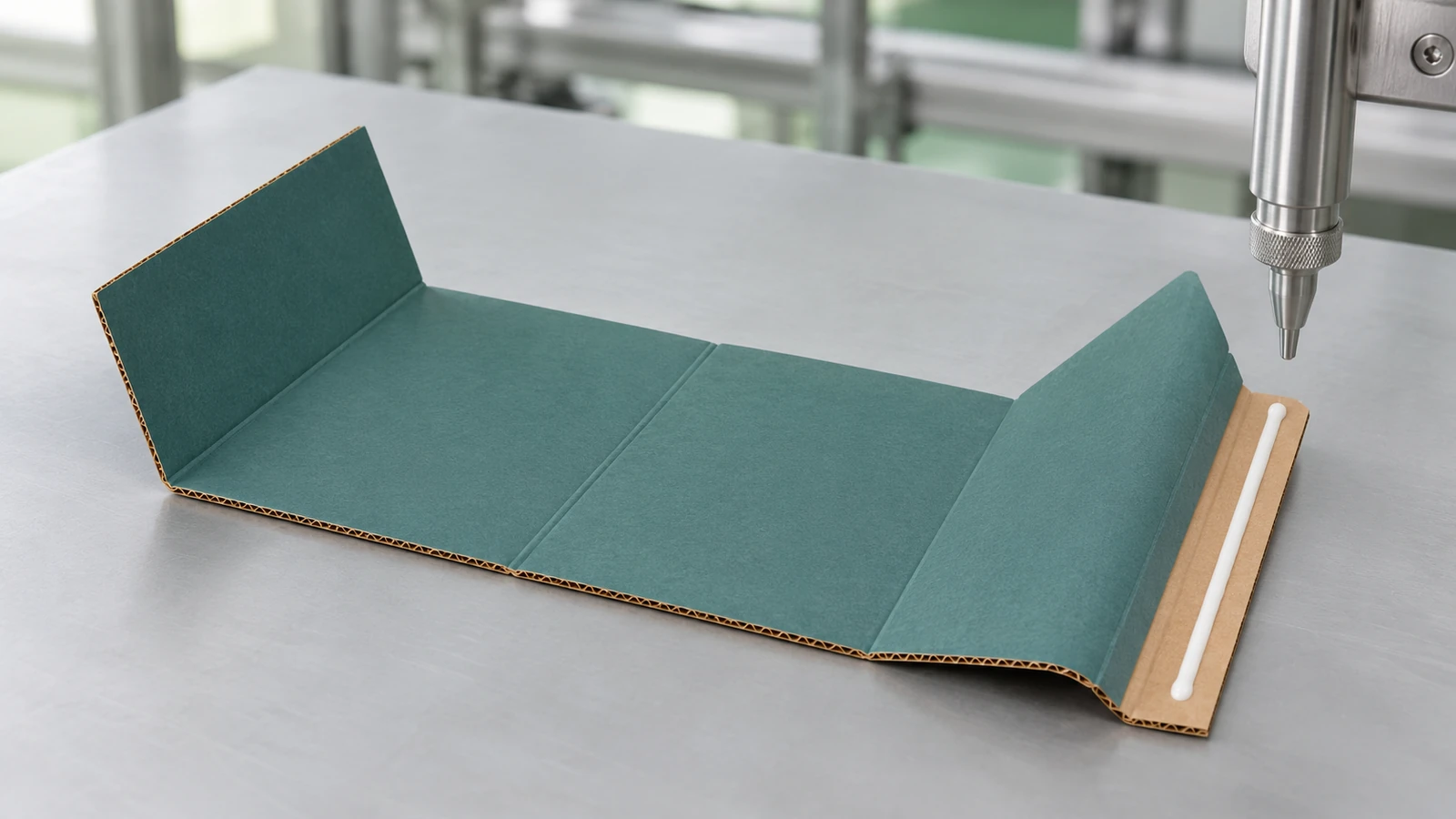
A detected glue trace is evidence about adhesive application, not by itself proof of the finished joint's strength or durability. For a corrugated box side seam, approve the actual bonding surfaces, adhesive and production conditions together. A machine setting or a clean-looking bead cannot replace that decision.
The distinction is timely. In its 24 November 2026 announcement, BOBST describes a redesigned MASTERFOLD range for corrugated folder-gluing, with connected job preparation, automated positioning and optional quality-control and ejection systems. Those capabilities concern production control. They do not establish the bond performance of a buyer's untested material combination, and the announcement does not mean that YOUNGSUN PAPER operates this equipment.
This guide concerns the manufacturer's side joint, where one flap overlaps another panel. It does not prescribe the starch bond between liner and fluting, or an adhesive for closing a filled box's top flaps. Keep those applications separate when requesting advice.
Name both surfaces, not just the board grade
On the drawing, mark the glue track and the area it contacts after folding. Record what is actually present on each surface: exposed liner, printing, coating, varnish or a laminated layer. Give the converter a finished printed blank as well as any plain board sample. An artwork change that extends a finish into the overlap can change the combination being approved.
An uncoated glue area can be specified where appropriate, but it is not a universal requirement for every adhesive. Jowat's product information for folding-box bonding identifies application-dependent options for challenging coated or varnished surfaces and stresses trials under normal processing conditions. Use the selected adhesive's current technical data and confirm the actual substrate pairing; do not transfer a catalogue indication to every coated board.
Include the finished corrugated construction, liner references, flute and caliper, blank dimensions, score positions and agreed tolerances in the record. If discussing kraft paper options, specify the intended liner use and the downstream construction. A paper grade reference alone is not a finished corrugated-board specification.
Ask what the monitoring system actually checks
Baumer hhs describes corrugated-board systems for monitoring adhesive traces, checking folded-blank gaps and detecting other production deviations. These are defined inspection tasks. Ask the converter which features are fitted, what is being measured, how the reference is set and how rejected products are handled.
The procurement implication is to keep the monitoring record and the finished-bond test as separate evidence. A trace sensor does not, merely by detecting adhesive, demonstrate how the joint performs after setting, storage or handling. Conversely, a passed sample does not prove that every later blank received the correct glue pattern. Both process control and representative product checks matter.
Run a comparison that can reveal the cause
Use the current approved construction as a control. Compare a candidate at documented production conditions, with the adhesive and converter teams involved. If changing the liner, surface finish and adhesive at once is unavoidable, identify the combined change explicitly rather than attributing the result to paper alone.
Record the adhesive reference and lot, application method, trace position and amount or agreed application measure, line speed, time to contact, compression conditions and time before inspection. Where relevant, include material conditioning and the adhesive's preparation or operating settings. This article supplies no universal temperature, viscosity, pressure or speed: use the supplier's current instructions and the converter's validated process.
Collect identified samples at startup, stable running and after a representative stop and restart. Retain records of settings and any rejected output. A successful hand-glued coupon can help screen a combination, but it does not reproduce every condition of a moving folder-gluer.
Read the joint, not only the glue trace
Agree sample quantity, inspection timing, conditioning, test method and acceptance limits before the trial. The table below is our suggested investigation checklist, not a standardized bond test or a diagnosis of a particular machine.
| Observation | Useful next check |
|---|---|
| Glue is detected but the seam opens | Verify the two contact surfaces, overlap, timing and compression against the approved setup; assess the bond after the agreed setting period |
| The seam is skewed or the gap varies | Compare blank dimensions, scores, folding alignment and actual overlap before changing adhesive |
| Paper or a surface layer separates | Identify which layer failed; distinguish surface or interlayer failure from adhesive release |
| Good initial samples change after storage | Repeat the agreed conditioning and inspection sequence with the control and candidate |
| Defects appear mainly after restart | Compare startup material, adhesive application and process records with steady production |
If an agreed method includes opening the joint, record where separation occurs and retain photographs and sample references. Fibre tear may be one observation, but do not invent a universal percentage or treat it as the only acceptance criterion. The converter or qualified lab should select a suitable assessment for the design and use.
Approve the revision, not a general promise
Link the accepted sample to the drawing revision, board lot, print finish, adhesive and line conditions. A later paper, coating or adhesive substitution should trigger a documented review. Where transport protection is required, assess the packed product and its complete shipping configuration separately from a side-seam sample.
For overseas sourcing, compare cost per accepted box as well as material price. Include setup waste, rejects, inspection and rework. Customers in Mexico, Colombia or Chile should state their real storage and distribution requirements, rather than inherit a test profile from a different supply chain.
Put the glue area in the RFQ
Send the box drawing, photographs of both overlap surfaces, board construction, printing and finish, adhesive reference if known, intended equipment and any failure sample. Identify whether the request concerns base paper, converted board or a finished box. See our packaging and printing applications, or send the paper specification to YOUNGSUN PAPER. We can discuss paper candidates and available documentation; the converter and adhesive supplier should qualify the side-joint process.
Frequently asked questions
Does a glue sensor prove that a corrugated box joint is strong?
No. Its evidence is limited to the features the system is designed and configured to inspect. Finished-joint performance needs an appropriate, separately agreed assessment.
Must every glue flap be left uncoated?
Not universally. Some adhesive systems suit particular coated surfaces, while other constructions may need a different glue area or adhesive. Confirm the exact combination by trial.
Can I approve the seam from a hand-glued sample?
A hand sample can help screen materials, but production approval should include the actual converting process, representative samples and the agreed inspection and conditioning sequence.