
Guides · 2026-09-11
Tracing Paper Overlays for Invitations and Presentation Packs
Translucent overlays can add a reveal to invitations and presentation materials. Explore three assembly options and learn how to align the artwork, paper choice and converting process before ordering.
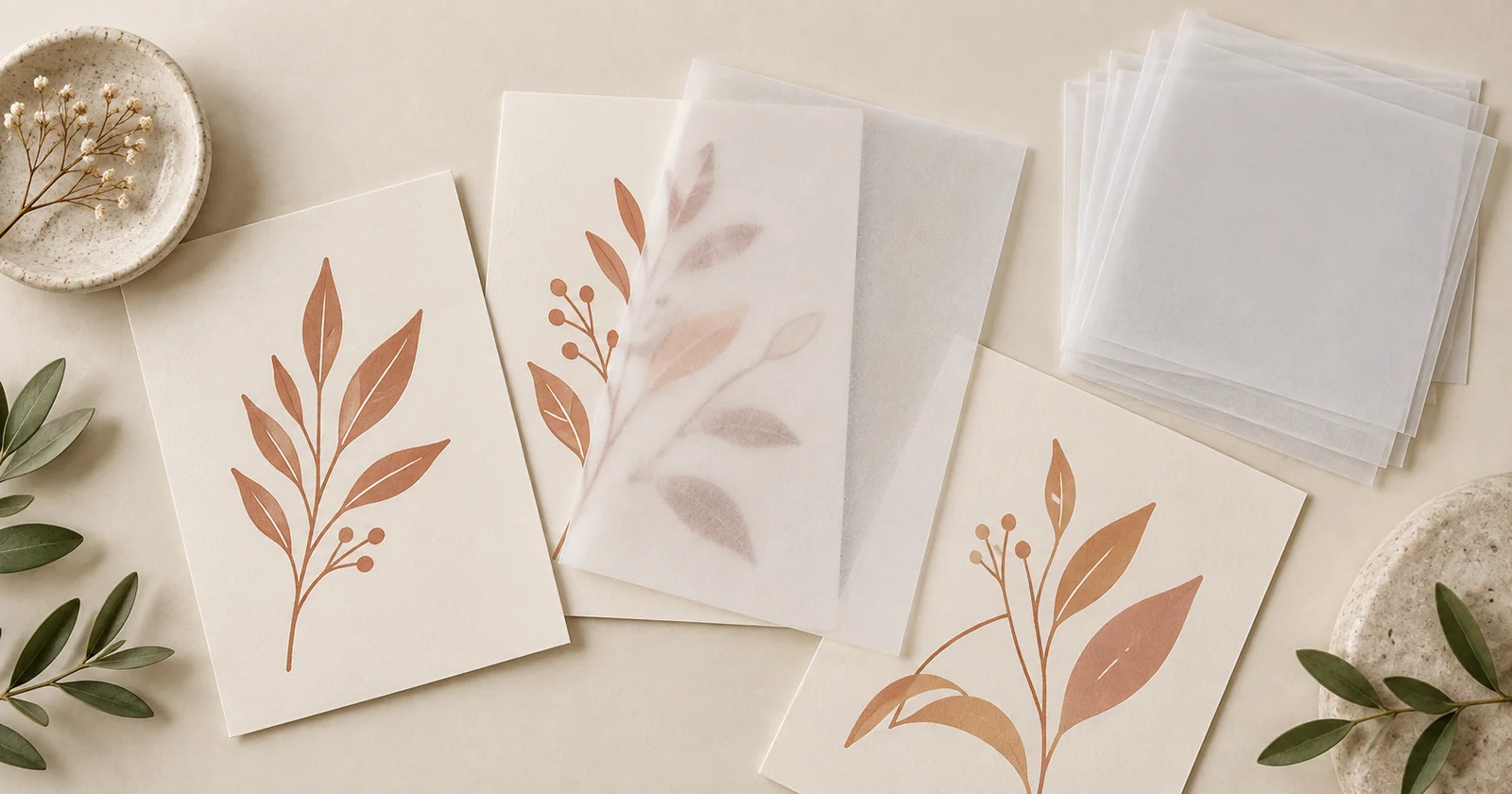
A tracing-paper overlay lets a designer reveal an image gradually: the reader first sees it through a translucent sheet, then lifts or turns that sheet to see the printed card beneath. For invitation printers and suppliers of presentation materials, the design opportunity is in the relationship between those two layers.
The practical starting point is to decide what the reader should see before opening the piece, what should become visible afterwards, and how the overlay will be attached. Paper selection and artwork should follow that decision.
Three Ways to Use a Translucent Layer
A Loose Invitation Insert
A loose overlay can sit above the invitation card inside an envelope. It avoids an attachment step, but the position is not fixed. Design the two layers so that small movements do not make the layout look incorrect.
Keep essential information easy to find. If names, dates or contact details must be read immediately, leave them uncovered or make the underlying card straightforward to access.
An Attached Presentation Leaf
A translucent leaf can introduce a photograph or illustration in a presentation pack. Use the first view to establish the visual theme; place detailed information on the page that follows.
Discuss the attachment with the converter before finalising the artwork. A bound edge, punched connection or adhesive attachment each needs an agreed layout. Make a physical mock-up to check page turning, alignment and any visible attachment marks.
A Folded Wrap Around a Printed Set
A wrap can hold the visual identity of an invitation set together. Define its overlap and closure position before choosing the finished dimensions.
A folded wrap needs a converting trial as well as a flat-sheet review. Ask the converter to assess the proposed fold and closure on the selected grade. Do not assume that a paper suitable for a loose insert will behave identically in a folded construction.
YOUNGSUN PAPER's tracing paper product page lists invitations, card inserts and overlays among its applications. Confirm the exact material for your design when making an enquiry.
Design the Two Layers Together
Plan the First View
Create a mock-up with the actual base card and artwork. View it under ordinary lighting, then lift the overlay and compare the two states.
Check whether the softened image is intentional and whether the uncovered version provides a clear next step for the reader. Avoid relying on fine details beneath the overlay for information that must be understood at first glance.
Check Artwork Overlap
If both sheets carry printing, review them together. Lines, shapes and lettering on one layer may visually compete with those on the other. Leave enough space around important content, and inspect the assembled piece at its final size.
A digital proof can establish position, but it cannot replace approval of the appearance through a physical sheet.
Keep the Back of the Piece in Mind
Turn the sample over. Review any printing visible from the reverse and decide whether that appearance is acceptable. Also inspect the assembly when closed, opened and placed inside its envelope or folder.
These are layout checks, not a promise that every translucent grade produces the same effect.
Choose the Material by Its Role
Start the material enquiry with the construction: loose overlay, attached leaf or folded wrap. Then describe the desired appearance and handling.
GSM measures mass per unit area. It does not, by itself, establish the translucent appearance, thickness or suitability for a particular print process. Ask for candidate samples and compare them over the same base artwork.
For a loose overlay, focus on the appearance and handling of the assembled invitation. For an attached leaf, also check how the sheet turns and sits in the pack. For a folded wrap, include the folds, overlap and closure in approval.
Record the approved grade and sample reference. Specify GSM, finished dimensions, sheet format and any required tolerances separately. If grain direction matters to the converter, mark it on the cutting layout.
Agree Printing and Assembly Before Ordering
Confirm compatibility with the exact printing equipment and process. Give the converter the intended artwork, including any solid areas and small text, and ask for a trial on the proposed paper.
Assess the completed trial after the printer's specified drying or curing period. Agree checks for handling, unwanted transfer and the final appearance. If foil, embossing or adhesive is part of the design, include that operation in the trial rather than approving an undecorated sheet alone.
For an attached overlay, inspect the attachment area through the paper. Position and appearance of the attachment should be approved as part of the design.
Ask the supplier and converter for storage and conditioning instructions appropriate to the selected grade. Keep the reference sample identified so that repeat orders can be compared against the approved construction.
Make the Enquiry Specific Enough to Quote
A useful request includes the finished dimensions, quantity and intended assembly, plus the proposed GSM if one has already been selected. Attach the artwork and a sketch showing the position of the overlay.
State the requested sheet format, cutting requirements, printing process, packing format and destination. If a translucent appearance must match an existing sample, supply that reference and explain how the comparison will be made.
Leave unknown fields explicitly open for recommendation. This is more useful than adopting a catalogue specification that has not been checked against the finished design.
Explore YOUNGSUN PAPER's culture paper range for the other layers in a printed set. To discuss a tracing-paper overlay, contact YOUNGSUN PAPER with your layout and sample requirements.
Frequently Asked Questions
What Is Tracing Paper Used for in Invitation Design?
Tracing paper can form a translucent overlay that reveals part of the card beneath. Designers can use a loose insert, an attached leaf or a folded wrap, subject to the selected material and construction.
Should Important Text Be Printed Beneath a Translucent Overlay?
If the text must be read immediately, keep it on an uncovered area or on a page the reader can access easily. Check the actual artwork under the proposed overlay before approval.
Can Any Tracing Paper Be Used in Any Printer?
No universal compatibility should be assumed. Confirm the exact paper grade with the printer or converter and run a trial using the intended equipment, artwork and finishing process.
What Information Is Needed to Quote a Tracing-Paper Overlay?
Provide the finished size, quantity, assembly style, proposed GSM, sheet format, artwork, printing process, packing needs and destination. Include a sample reference for the desired translucent appearance.