
Packaging Procurement · 2026-11-11
Folding Boxboard with Straw Fiber: What Does the Percentage Tell You?
A recent model puts agricultural-residue pulp in the middle layer of a folding boxboard. Here is what to ask before you qualify a grade or compare a quote.
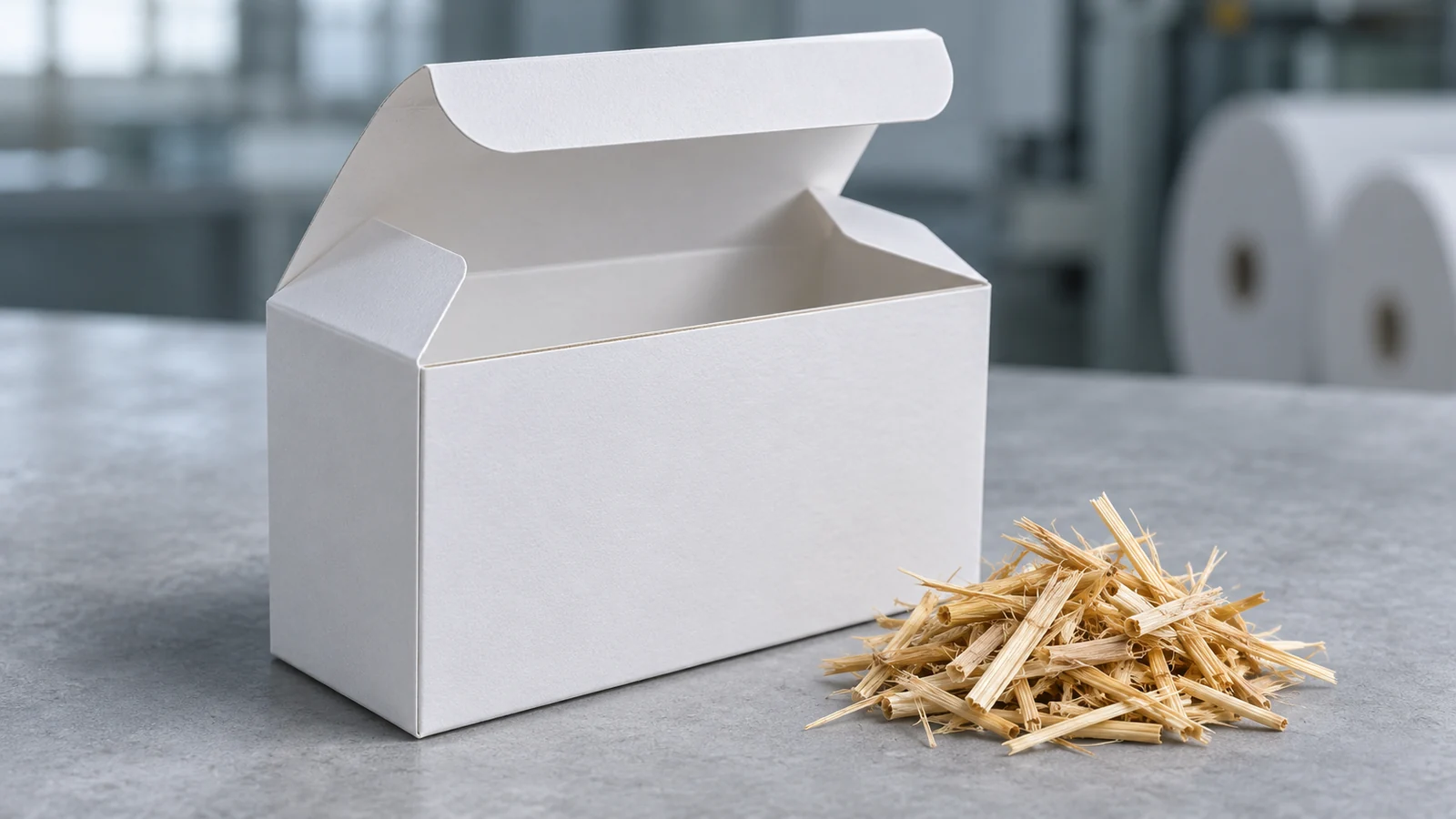
A folding boxboard can contain pulp made from wheat straw or sugarcane bagasse without looking any different from your current board. If the new fiber is in the middle layer, you may still see white, printable faces. The sourcing question is not whether you can see the fibers, but what the percentage measures and whether the board performs in your carton.
In its November 2026 white paper, Seeing the Field and the Forest, Canopy modeled a high-performance, three-layer folding boxboard made by an illustrative integrated mill in China. The model put the alternative pulp in the middle layer. Under its price and operating assumptions, it estimated that alternative pulp could account for about 8% of the optimal fiber mix for that board by 2028. Packaging Insights covered the research on 11 November. This was a preliminary economic model, not an observed adoption rate, a commercial quote, a certified content claim or a guarantee for other mills or grades.
Find out what the percentage is measured against
Ask the supplier to write out the numerator and denominator. An agricultural-fiber share of the middle layer is not the same as its share of all dry fiber in the board, and neither is necessarily its share of finished sheet weight, which can also include coatings and other non-fiber material. For example, if the middle layer contains half of the total dry fiber and 10% of that layer's dry fiber is agricultural, then agricultural fiber accounts for 5% of total dry fiber. This is an arithmetic example, not a material specification.
Ask for the residue type, layer, calculation basis, and whether the percentage is a minimum, a target with a tolerance, or an average. Ask what is documented for the grade and what can be confirmed for each lot. Do not use a supplier's percentage as a finished-package marketing claim without checking that the wording and evidence actually cover the finished pack.
Trial the candidate against the approved carton
Keep the current folding boxboard as the control. Compare the datasheets first: grammage, caliper, bending resistance in machine and cross directions, and the appearance of both faces. For bending values, confirm that the test method and conditions match; ISO 2493-1 is one reference for a two-point method. Matching grammage alone is not a drop-in approval.
Print and convert the candidate using the actual artwork, grain direction and die. Record any adjustments and inspect print appearance, fold cracking, glue seams, feeding and carton closure. Then pack the intended product. A material that needs a different crease setup might still be usable, but its cost and repeatability must be assessed with that setup. If the first samples pass, ask for a representative production lot before removing the current grade from the approved list.
Compare cost per usable carton, not just cost per tonne
Use the same order volume, sheet dimensions, destination and delivery terms. Divide the landed board cost and relevant conversion costs by the number of accepted cartons from the trial. Count setup waste, rejected cartons and any extra converting steps. A cheaper tonne does not necessarily produce cheaper cartons if a different sheet size reduces the number of blanks per sheet or the board generates more rejects.
Supply diversification is a separate benefit to verify. Ask how the pulp is sourced, how seasonal changes are handled, what substitutions can occur, and which changes require your approval. A new fiber source broadens your options only if you can repeatedly buy board that meets the approved specification.
Start your request with the job, not the fiber claim
Share the carton dimensions, artwork, existing grade and measured caliper, print and finishing process, monthly volume and delivery destination. Mark which requirements are mandatory and whether you are exploring an alternative furnish or need a documented minimum content. For a baseline grade or sample comparison, browse our packaging and printing applications or send your board specification to YOUNGSUN PAPER. The report does not establish that the agricultural-fiber blend it modeled is available from YOUNGSUN.
Frequently asked questions
Is the modeled 8% a purchase specification?
No. It was a result for an illustrative board and set of assumptions. Confirm the percentage, calculation basis, tolerance and evidence for the actual grade.
Can I identify a straw or bagasse blend by looking at the carton?
Not reliably. A white outer layer can cover a different middle layer. Ask for written composition and content documentation rather than judging by color.
Does agricultural fiber prove recyclability or food-contact suitability?
No. Both questions depend on the actual finished construction and intended use or market. The fiber source alone does not establish either.