
Guides · 2026-07-30
Making the Most of Trade Show Paper Samples: What to Look For and What to Ask
The paper samples you collect at trade shows are the foundation of your sourcing decisions. This guide teaches you how to evaluate samples on the spot, what tests to request, and how to avoid the most common sample evaluation mistakes.
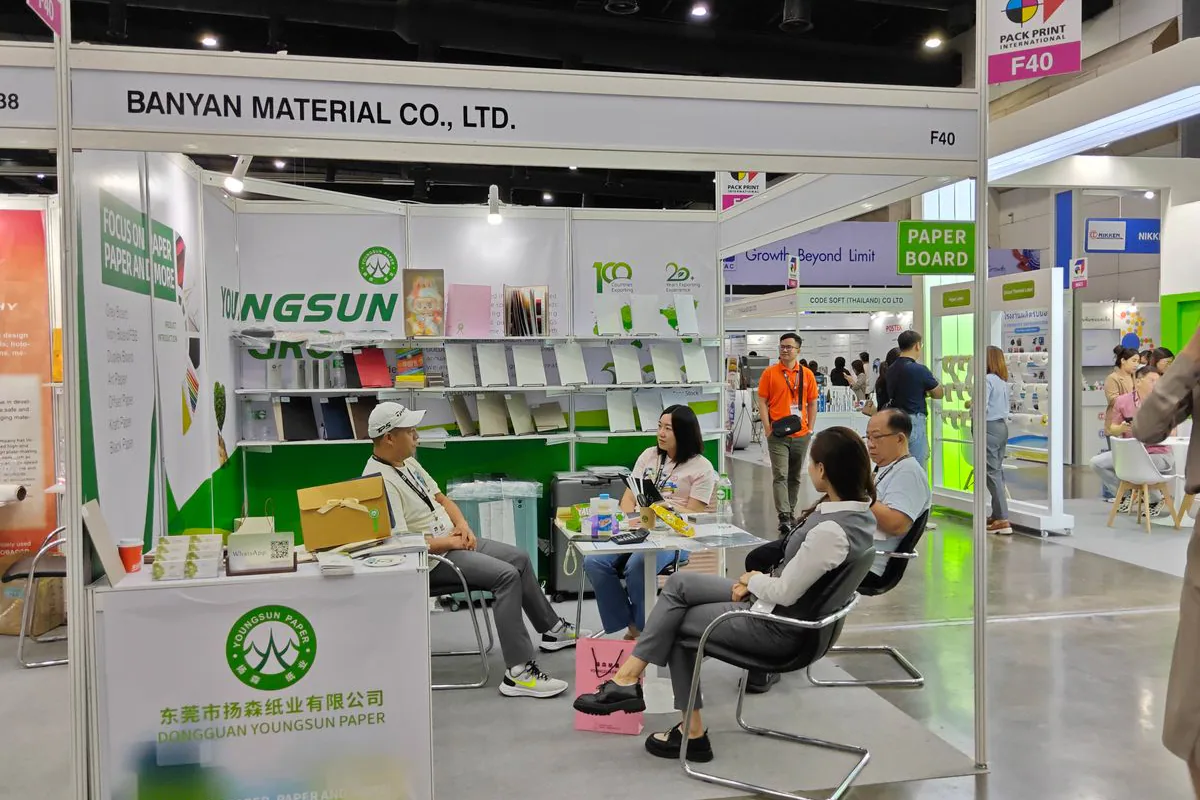
A trade show sample is a promise. The supplier is saying: "The paper we deliver will be like this." But a sample that looks perfect at the booth may behave completely differently on your production line — different printing, different folding, different humidity, different everything.
This guide covers how to evaluate trade show paper samples effectively, what follow-up tests to request, and the most common mistakes buyers make with samples.
The Two Purposes of a Trade Show Sample
A trade show sample serves two different purposes, and confusing them leads to bad decisions:
| Purpose | What You're Evaluating | When to Trust It |
|---|---|---|
| First impression | Does this paper feel right? Does the surface, color, and stiffness match what I need? | Immediately — your hands and eyes don't lie |
| Production prediction | Will this paper run on my press? Will it die-cut cleanly? Will it fold without cracking? | Only after testing on your actual production line |
The #1 sample mistake: Approving a supplier based on trade show booth samples without production testing.
Hands-On Evaluation at the Booth
You can learn a lot about paper in 3-5 minutes with nothing but your hands and eyes.
The 60-Second Surface Assessment
- Run your fingertips lightly across the surface — is it smooth, textured, velvety, or rough? Is the texture consistent across the entire sheet?
- Hold the sheet at a 45° angle to the light — does the surface reflect evenly? Any visible coating defects, streaks, or dull spots?
- Look at the sheet edge-on — is it a single ply or laminated? For through-dyed papers, does the color go all the way through?
- Smell the paper (important for food-grade papers) — any chemical, musty, or unusual odor?
The Stiffness and Handling Check
- Hold the sample by one corner — how much does it droop? Compare to your current stock at the same GSM.
- Gently wave the sheet — does it feel rigid and crisp, or limp and soft?
- Try a rough fold (ask permission first if it's a display sample) — does it crease cleanly or crack? Is there a white line at the fold?
- Rub two sheets together — do they slide smoothly or catch? This matters for sheet-fed printing and converting.
The Print Surface Check (If Pre-Printed)
If the sample has printing on it:
- Check registration — are colors aligned? Any visible misregistration?
- Check dot quality — look closely at halftone areas; are dots clean or ragged?
- Check solid areas — are they uniform or mottled?
- Rub the printed surface with your thumb — does the ink smudge or stay put?
- Check the reverse side — any show-through?
What the Booth Sample CANNOT Tell You
A 3-minute booth inspection cannot tell you:
- How the paper runs on a high-speed press at 15,000 sheets per hour
- Whether it will jam in your die-cutter
- How it absorbs ink with your specific ink and press settings
- Whether the coating will crack when folded on your automated folder-gluer
- How it behaves at your factory's temperature and humidity
- Whether batch 2 will match the booth sample quality
The Follow-Up Sample Request: What to Ask For
Before leaving the booth, request these follow-up items:
1. A4 Blank Samples of the Exact Grade
Ask for 10-20 blank sheets of the exact grade and GSM you're evaluating, shipped to your office. These are for:
- Printing tests on your press
- Die-cutting and folding tests on your converting line
- Gluing and assembly tests
- Comparing against your current stock under your lighting conditions
2. Printed Samples from a Production Run
A pre-printed booth sample may have been produced under ideal conditions on the supplier's best equipment. Ask for printed samples from a regular production run — same grade, same printing method, but from a commercial job.
3. A Technical Data Sheet
This should include:
- Guaranteed GSM and caliper (± tolerance)
- Brightness (ISO %)
- Opacity (%)
- Smoothness (Bendtsen or Bekk)
- Moisture content range
- Tensile strength (MD and CD)
- Tear strength (MD and CD)
- Burst strength (for packaging grades)
- Stiffness (for board grades)
4. Certification Documentation
- FSC certificate number (verify at info.fsc.org)
- SGS test reports (if available)
- Food-contact compliance documents (if applicable)
- ISO 9001/14001 certificates
Sample Evaluation at Your Facility: The Production Test
When samples arrive at your facility, test them under your real production conditions:
| Test | What to Check | Pass/Fail Criterion |
|---|---|---|
| Printing | Registration, dot gain, ink drying, color accuracy | Matches or exceeds current stock within acceptable tolerance |
| Die-cutting | Edge quality, dimensional accuracy, tool wear | Clean edges, ±0.5mm dimensional tolerance |
| Folding/Creasing | Crack-free folds, consistent crease depth | No visible cracking at crease under magnification |
| Gluing | Bond strength, open time, coverage | Full bond within specified open time |
| Lamination | Adhesion, bubble-free, edge seal | No delamination at cut edges |
| Embossing/Foil | Depth consistency, foil adhesion, detail retention | Clean reproduction of finest detail element |
Red Flags in Sample Evaluation
🚩 "This is a hand sheet, production will be similar" — Hand sheets and production sheets are not the same. Insist on seeing a production sample.
🚩 The sample is a different GSM than what you're quoting — A 250 gsm sample does not represent 350 gsm production. Request the exact GSM.
🚩 The sample looks perfect but the supplier can't provide technical data — Beautiful paper with no data is a risk. Demand the spec sheet.
🚩 "The sample is from last year's production" — Formulations change. Request a recent production sample.
🚩 The supplier has no answer for "What happens if the production doesn't match the sample?" — Clear quality guarantees and claim procedures should be established before ordering.
Sample Documentation: Your Internal System
Create a simple sample log:
``` Sample ID: 2026-EXPO-042 Supplier: [Name] Grade: Grey Board 1.5mm Date Collected: July 15, 2026 Booth Contact: [Name] / [Email] / [Phone] Initial Impression: Good stiffness, consistent color, slight surface roughness Follow-Up Requested: A4 sheets, production sample, technical data sheet Quotation Status: Requested July 17 / Received July 19 / Under review ```
Six months later, when you can't remember which supplier had the grey board with the good stiffness, this log is invaluable.
YOUNGSUN Sample Policy
At YOUNGSUN PAPER, we make sampling straightforward:
- Free samples of standard products shipped within 3-5 business days
- Production-run samples available for serious inquiries — not hand sheets, not lab samples
- Technical data sheets provided with every sample shipment
- FSC and SGS documentation included when applicable to the grade
- Pre-production samples available before bulk orders — same specification, same production line
Request samples with your required grade, GSM, sheet size, and application. Specify whether you need blank sheets, printed samples, or both.