
Guides · 2026-07-24
Paper Thickness Explained: GSM, Caliper, Microns, and Points — A Complete Guide for Buyers
GSM, caliper, microns, points — paper thickness has multiple measurement systems. This guide explains each one, how they relate, and how to specify thickness correctly in your purchase order.
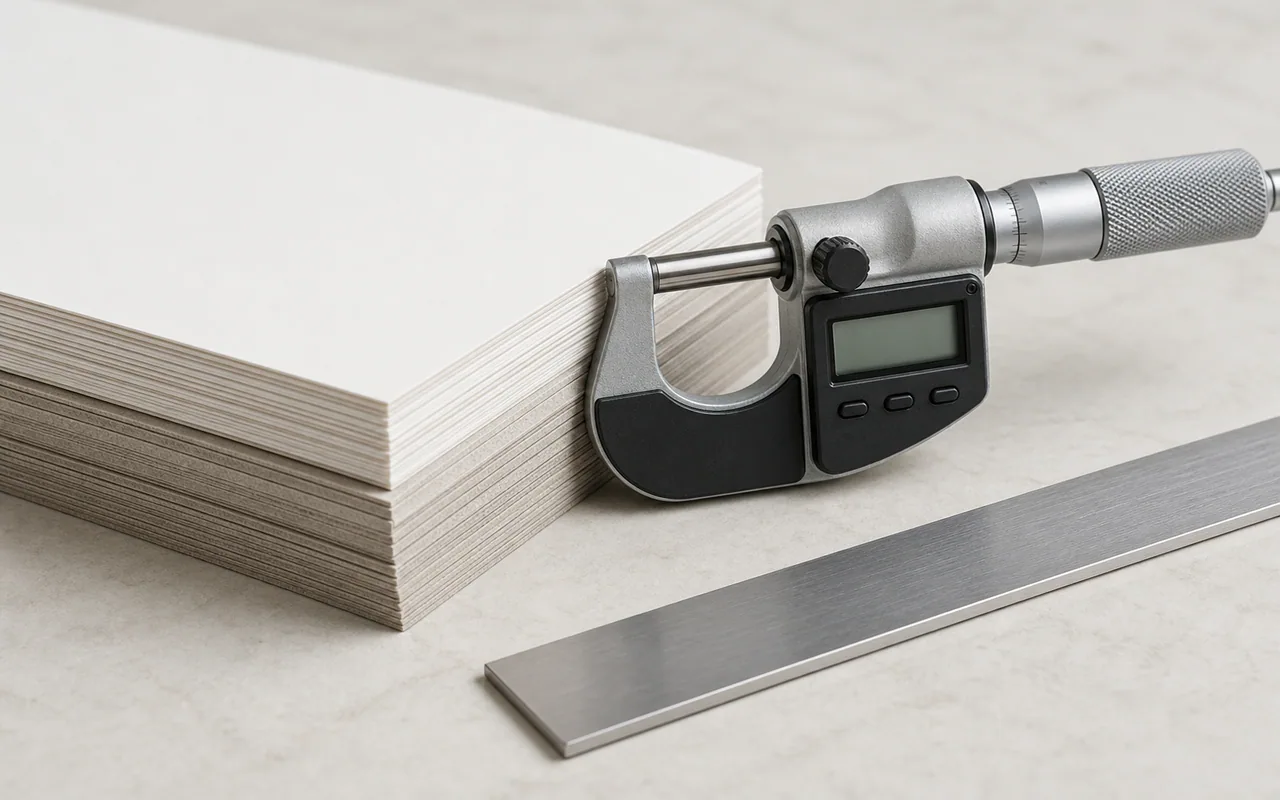
"I need 300 gsm paper." It's the most common specification in paper buying — and one of the most frequently misunderstood. A buyer who specifies only GSM without understanding caliper may receive paper that is technically correct but practically wrong for their application.
This guide explains the four main paper thickness measurement systems, how they relate to each other, and how to avoid the most common specification mistakes.
The Four Measurement Systems
1. GSM (Grams per Square Meter)
What it measures: The weight of a single sheet of paper measuring 1 meter × 1 meter.
Example: A 300 gsm paper means one square meter of that paper weighs 300 grams.
Best for: Comparing papers of the same type. Two 300 gsm woodfree papers will feel similar. But a 300 gsm grey board and a 300 gsm art paper will have completely different thicknesses because density varies by fiber composition and manufacturing process.
Limitations: GSM does NOT tell you thickness. A dense, compressed paper can have the same GSM as a bulky, airy paper but be half as thick.
2. Caliper (Thickness)
What it measures: The actual physical thickness of a single sheet, measured in microns (µm) or millimeters (mm).
Example: A 300 gsm grey board might have a caliper of 450 microns (0.45mm), while a 300 gsm C2S art paper might be only 280 microns (0.28mm).
Best for: Applications where physical thickness matters — rigid box fit, spine width of a book, stacking height, die-cutting clearance.
How it's measured: A precision micrometer applies standardized pressure to the sheet. Measurement conditions (temperature, humidity) affect results because paper expands and contracts with moisture.
3. Microns (µm)
What it measures: The same as caliper — physical thickness. 1 micron = 0.001 millimeter.
Why it's used: Microns are common in Asia and Europe. Millimeters are more common in North America.
Conversion:
- 1000 microns = 1.0 millimeter
- 500 microns = 0.5 millimeter
- 100 microns = 0.1 millimeter
4. Points (pt)
What it measures: Thickness in thousandths of an inch. Used primarily in North America.
Conversion:
- 1 point (pt) = 0.001 inches = 25.4 microns
- 10 pt = 0.010 inches ≈ 254 microns ≈ 0.25 mm
- 24 pt = 0.024 inches ≈ 610 microns ≈ 0.61 mm
The Density Factor: Why GSM ≠ Thickness
Paper density is the bridge between GSM and caliper. Two papers with identical GSM can have dramatically different calipers because of different densities.
| Paper Type | Typical Density | 300 GSM Caliper |
|---|---|---|
| Grey board (high density) | 0.75–0.85 g/cm³ | ~350–400 µm (0.35–0.40 mm) |
| Woodfree paper (medium density) | 0.70–0.80 g/cm³ | ~375–430 µm (0.38–0.43 mm) |
| FBB (medium density) | 0.60–0.75 g/cm³ | ~400–500 µm (0.40–0.50 mm) |
| C2S Art paper (lower density) | 0.55–0.70 g/cm³ | ~430–550 µm (0.43–0.55 mm) |
*Actual values vary by manufacturer, fiber type, filler content, and calendering.*
Common Specification Mistakes
Mistake 1: Specifying only GSM
"I need 300 gsm paper" — but 300 gsm grey board is 0.4mm thick while 300 gsm art paper may be 0.5mm thick. If your die-cutting tooling is set for 0.4mm and you receive 0.5mm, you'll have problems.
Fix: Always specify BOTH GSM and target caliper with tolerance. > "300 gsm (±5%), caliper 400 µm (±20 µm)"
Mistake 2: Confusing points with GSM
A North American buyer asks for "12 point board." An Asian supplier unfamiliar with the points system quotes 12 gsm. Result: the buyer receives paper 0.3mm thick instead of the 0.3mm expected — but at 1/25th the weight.
Fix: Always provide thickness in both systems. > "12 pt (0.012 inches / 305 microns)"
Mistake 3: Not specifying measurement conditions
Paper thickness changes with humidity. A sheet measured at 50% RH in a Chinese factory in winter may read differently at 65% RH in a Brazilian warehouse in summer.
Fix: Reference the test standard. > "Caliper measured per TAPPI T411 at 50% RH, 23°C"
Mistake 4: Ignoring bulk requirements for books
Book publishers care about bulk (pages per inch or cm). Specifying only GSM without bulk specification can result in a book that is 20% thicker or thinner than expected — changing the spine width and cover design.
Fix: Specify bulk. > "Bulk: 1.8 cm³/g minimum"
How to Write a Bulletproof Thickness Specification
``` Product: Folding Box Board GSM: 300 ±5% Caliper: 420 µm ±20 µm (per ISO 534) Bulk: 1.4 cm³/g minimum Measurement conditions: 23°C, 50% RH ```
This specification tells the supplier exactly what you need, how to measure it, and what tolerance is acceptable. No ambiguity. No surprises.
Quick Reference Table
| Measurement | Unit | Region | Use Case |
|---|---|---|---|
| GSM | g/m² | Global (standard) | Material specification, pricing |
| Microns (µm) | 0.001 mm | Asia, Europe | Physical thickness |
| Millimeters (mm) | 1.0 mm | Global | Physical thickness |
| Points (pt) | 0.001 inch | North America | Physical thickness |
The Bottom Line
Specify GSM for weight and pricing. Specify caliper for physical thickness. Never assume one predicts the other. The five minutes it takes to write a proper dual specification will save weeks of delay, rework, and dispute resolution.
Need help specifying your project? Contact our technical team — we'll help you write a specification that ensures you get exactly what you need.