
Guides · 2026-07-24
Paper Moisture Content: Why It Matters and How to Control It for Export Shipments
Paper moisture content affects everything — print quality, dimensional stability, converting performance, and shelf life. This technical guide covers measurement, ideal ranges, and ocean freight moisture protection.
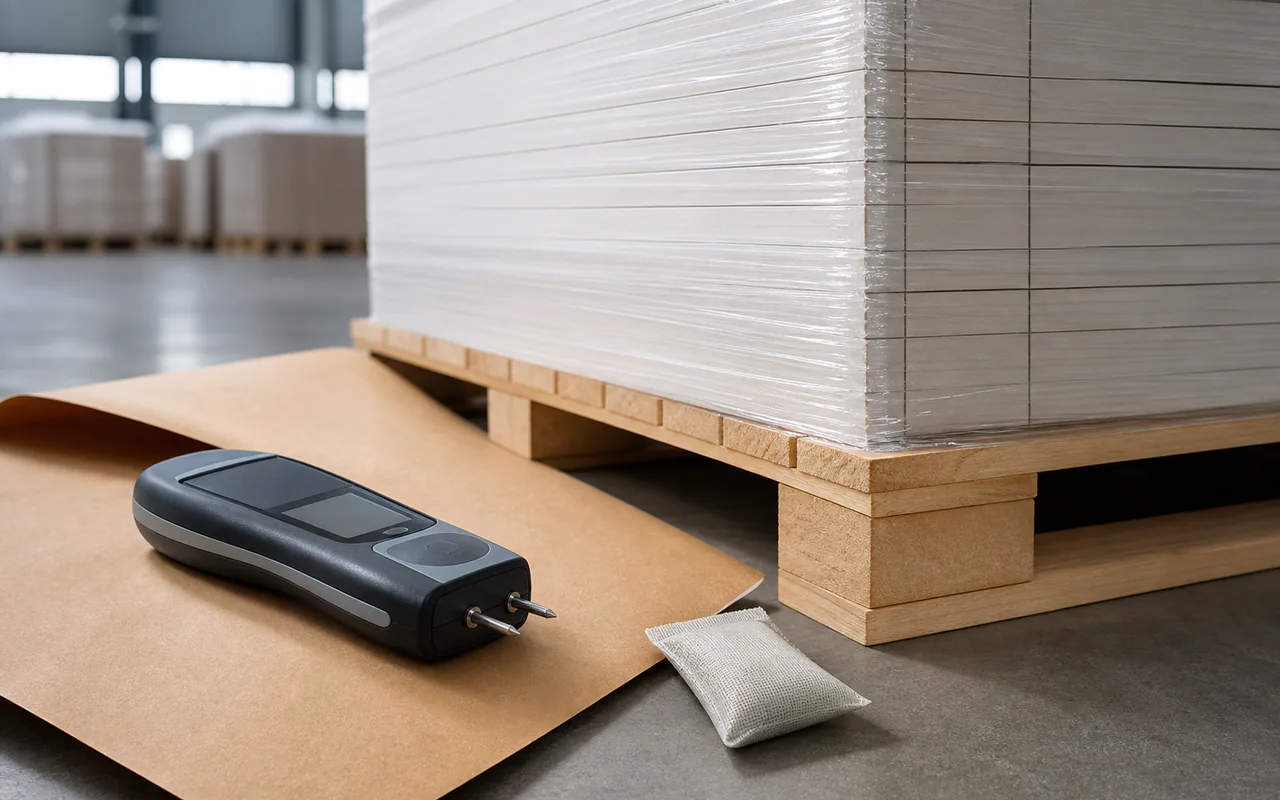
Paper is hygroscopic — it absorbs and releases moisture from the surrounding air. A sheet of paper that measures perfectly at 50% relative humidity in a Chinese factory may arrive in Europe or the Middle East with completely different physical properties.
For international buyers importing paper by ocean container, moisture content is one of the most common causes of quality disputes — and one of the easiest to manage with proper specification and handling.
What Is Paper Moisture Content?
Paper moisture content is the percentage of water weight in a sheet of paper relative to its total weight.
Example: A 100-gram sheet with 7% moisture content contains 7 grams of water and 93 grams of fiber and filler.
Why Moisture Content Matters
1. Dimensional Stability
Paper expands when it absorbs moisture and shrinks when it dries. This is not uniform — paper expands more across the grain than along the grain. A 1% change in moisture content can cause a 0.1–0.2% dimensional change.
For a 1,000mm sheet, that's 1–2mm of expansion. For multi-color printing requiring precise registration, this is enough to cause misregistration and waste.
2. Print Quality
- Too dry (<4%): Static electricity, poor ink adhesion, brittle paper that cracks on folding.
- Too wet (>9%): Ink smearing, slow drying, wavy edges, poor toner adhesion in digital printing.
- Optimal (5–7%): Clean ink transfer, predictable drying, stable dimensions.
3. Converting Performance
Die-cutting, creasing, and folding all depend on the paper having the right moisture level. Overly dry paper cracks on the crease. Overly wet paper stretches and tears.
4. Mold and Mildew
Moisture content above 10% combined with warm temperatures creates conditions for mold growth. A container of paper that gets hot and humid during a 30-day ocean voyage is at risk.
Ideal Moisture Content by Product Type
| Product | Ideal MC | Notes |
|---|---|---|
| Grey board | 7–9% | Dense board tolerates slightly higher MC |
| Duplex board | 6–8% | Balance print surface with structure |
| FBB | 6–8% | Virgin fibre, stable |
| Woodfree paper | 5–7% | Lower MC for better print registration |
| C2S Art paper | 5–7% | Coating provides some moisture barrier |
| Kraft paper | 6–8% | Natural kraft absorbs/desorbs quickly |
| Greaseproof paper | 5–7% | Dense structure, slow moisture exchange |
| Cupstock | 6–8% | PE coating provides moisture barrier |
How Moisture Content Is Measured
Oven-Dry Method (Reference Standard)
A sample is weighed, dried in an oven at 105°C until all moisture evaporates, then re-weighed. The weight difference is the moisture content.
Standard: ISO 287, TAPPI T412 Accuracy: ±0.1% Limitation: Destructive, takes hours
Electronic Moisture Meter
A handheld meter measures electrical resistance or capacitance, which correlates with moisture content.
Standard: Calibrated against oven-dry method Accuracy: ±0.5–1% Advantage: Instant, non-destructive
Moisture Protection During Ocean Freight
Ocean containers experience extreme conditions: daytime solar heating (container interior can reach 60°C/140°F), nighttime cooling, and humidity fluctuations from 40% to 95% RH.
The "Container Rain" Problem
When a container cools at night, moisture in the air condenses on the container walls and ceiling. This "container rain" can drip onto paper cargo, causing localized water damage — wavy edges, stuck sheets, and mold.
Protection Methods
- Moisture Barrier Wrapping: Entire pallets wrapped in polyethylene film with taped seams.
- Desiccants: Silica gel or calcium chloride desiccant packs placed inside the container. A 40HQ container typically needs 10–15 kg of desiccant.
- Container Liner: A kraft paper or polyethylene liner inside the container walls absorbs condensation before it reaches the cargo.
- Kraft Paper Interleaving: Top and bottom of each pallet covered with absorbent kraft sheets.
YOUNGSUN's Standard Export Packing
- All pallets wrapped in moisture-barrier PE film
- 10 kg calcium chloride desiccant per 40HQ container
- Container floor lined with kraft paper
- Photo documentation of packing before container sealing
What to Check When Your Container Arrives
- Inspect the container exterior for damage, holes, or signs of water ingress.
- Open the container and check for condensation on walls/ceiling.
- Check desiccant packs — if they are saturated (hard/full), the container experienced high humidity.
- Random moisture meter testing of 5–10 sheets from different pallets.
- Visual inspection for wavy edges, discoloration, mold spots, or stuck-together sheets.
If moisture is outside the agreed specification (±1% from target), document it immediately with photos and notify your supplier.
How to Specify Moisture Content in Your Purchase Order
``` Moisture content: 7.0% ±1.0% (per ISO 287 oven-dry method) Packing: PE-wrapped pallets, 10 kg desiccant per 40HQ container Storage before shipping: Conditioned at 23°C, 50% RH for minimum 48 hours ```
The Bottom Line
Moisture content is invisible — you cannot see whether a sheet is at 6% or 9% MC by looking at it. But you will see the consequences in your printing press, die-cutter, or folder-gluer. A 30-second moisture meter check at receiving can prevent hours of production downtime.
Contact our quality team for moisture content specifications and test reports for your product grade.