
Food Packaging · 2026-11-18
Paper Butter Wrap: Why Isn't Grease Resistance Enough?
A clean-looking grease test does not qualify a butter wrapper. Start with the finished pack, its folded corners and the storage conditions your customer actually uses.
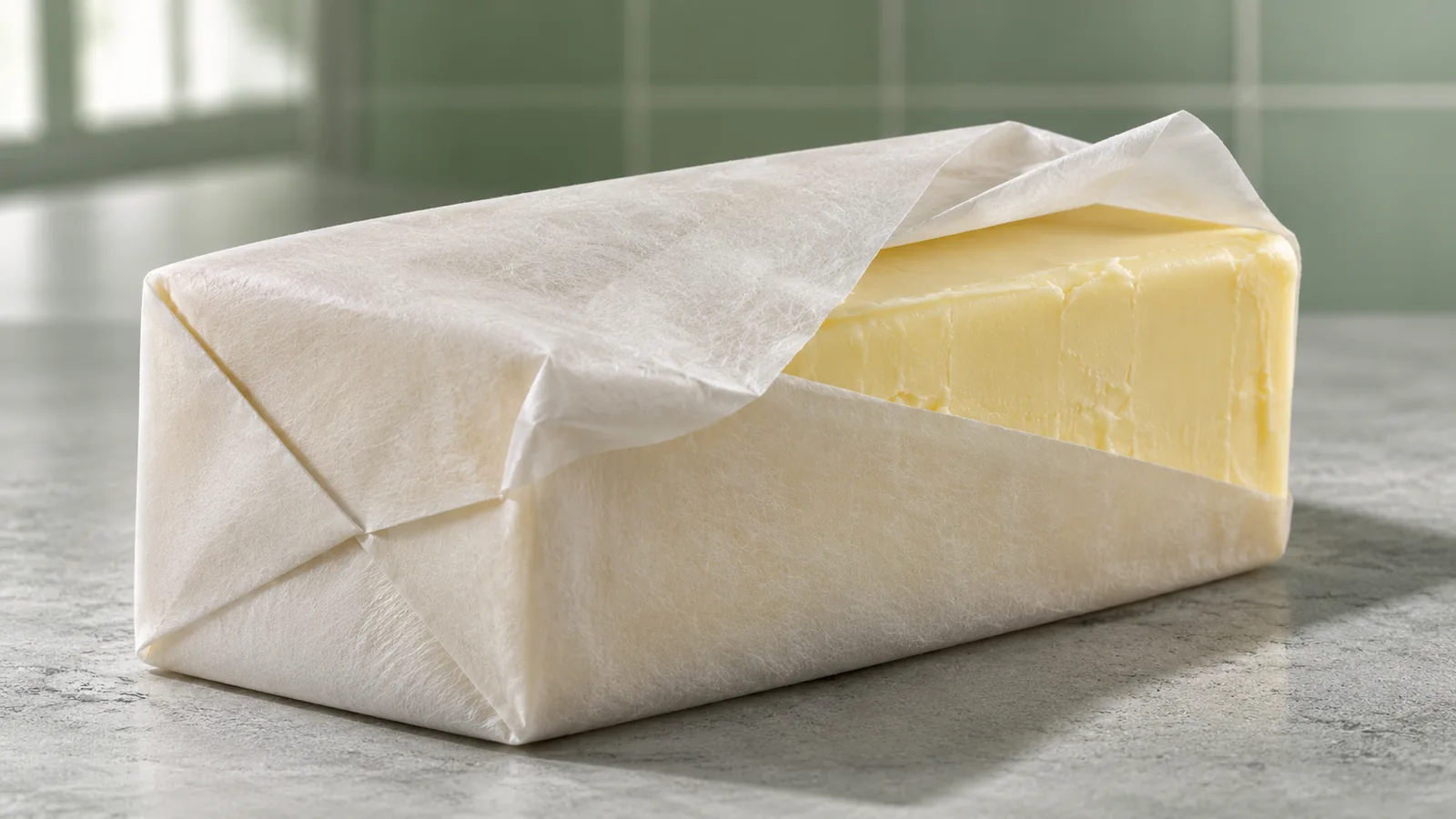
Grease resistance is one requirement, not a complete specification for paper butter wrap. Before replacing an existing pack, a buyer needs evidence for the actual food, folded construction, storage conditions and wrapping line. A flat paper sample cannot answer all four questions.
The distinction matters after Constantia Flexibles announced a paper-based butter wrap with NÖM on 12 November 2026. The supplier reports comparable shelf-life performance to its aluminum-based reference in tests with salted and unsalted butter, plus suitability for existing wrapping equipment. Those findings concern its developed construction, not ordinary greaseproof paper or every butter product.
Start with the pack you are replacing
Keep an approved current wrapper as the control. Write down the butter formulation, pack weight and geometry, target shelf life, storage range, distribution route and relevant wrapping settings. If salted and unsalted products are both sold, list both rather than assuming that approval transfers between them.
Separate the paper substrate from the finished structure: coating, printing, adhesives and any additional layers belong in the specification. Ask which surface touches the food and which side runs against machine parts. The manufacturer's own EcoPaperHighPlus product page recommends product-specific shelf-life trials rather than guaranteeing protection for all products. Treat any proposed alternative with the same discipline.
Four checks a grease test cannot replace
The following is our suggested buyer approval framework, not a universal test standard or a claim about a YOUNGSUN PAPER grade. Agree methods, sample sizes, conditions and acceptance limits with the converter, food producer and qualified laboratory before testing.
| Approval question | What to request or compare | What it does not prove alone |
|---|---|---|
| Does the material resist grease? | The method, exposure conditions and results for the supplied grade; inspect finished folds as well as flat areas | Protection against every other shelf-life risk |
| Does the wrapper stay folded? | Fold retention, often called deadfold, on the actual pack after wrapping and handling | Performance at a different pack size or line setting |
| Does the packed butter retain acceptable quality? | A controlled shelf-life comparison against the current pack under agreed storage and distribution conditions | A result for another formulation or route |
| Can the line produce acceptable packs consistently? | A converter trial recording speed, stops, waste, fold position and surface damage | Reliable production based only on a hand-wrapped sample |
Pay particular attention to corners and overlaps. Inspect the pack immediately after wrapping, after the agreed storage period and after representative handling. Record where a fold lifts or the surface is damaged rather than reporting only that the sample “passed.” If a candidate fails, retain the failed pack and its material lot information before changing settings or ordering another grade.
Shelf-life evidence should identify the comparison
Ask for the test report or an appropriate technical summary, not only a shelf-life claim. It should identify the packaging construction, food tested, reference pack, conditions, observation points and acceptance criteria. Have the food producer and laboratory decide which quality and safety endpoints are needed. Do not invent a storage duration or transfer a reported result to a different product.
For a refrigerated distribution route, document the intended route and foreseeable handling conditions. If frozen storage is part of the brief, validate that use separately; do not add an arbitrary freeze-thaw cycle and call it representative. A buyer in Mexico, Colombia or Chile should use the conditions of that supply chain rather than inherit a European trial profile without review.
Keep food-contact and recycling evidence separate
For EU sales, the European Commission's food-contact legislation overview explains the safety and inertness framework, including unacceptable changes to food composition, taste or odor. Ask a qualified specialist which requirements apply to the complete construction and intended use. A recycling report is not food-contact clearance; EU evidence is not automatically approval in every Latin American market.
Likewise, a paper appearance is not proof that the final printed, coated pack will be collected and recycled locally. The 4evergreen evaluation protocol addresses technical performance in specified recycling processes. Request evidence for the final construction and check the destination's collection and sorting arrangements before choosing disposal wording.
Send a brief that can produce a useful answer
Include the current structure or sample, butter type, pack dimensions, food-contact side, target storage life, temperature conditions, wrapping equipment, roll width and destination market. State which evidence is already available and which still needs validation. Compare cost per accepted pack, including wrapping waste and stoppages, rather than price per tonne alone.
Our greaseproof paper page is a starting point for discussing substrate requirements, not a representation that a listed grade replaces a validated butter wrap. Explore food and beverage applications or send your material brief to YOUNGSUN PAPER. We can discuss candidate paper and available documentation; finished-pack qualification belongs with the food producer and converter.
Frequently asked questions
Can ordinary greaseproof paper replace a butter wrapper?
Not on the basis of grease resistance alone. The proposed construction needs validation for the food, folding behavior, shelf life and wrapping process.
What does deadfold mean for butter packaging?
It describes the material's ability to retain a fold after folding pressure is removed. Assess it on the intended pack and wrapping line, not only by bending a loose sheet.
Does a paper recycling test prove food-contact suitability?
No. Technical recyclability and food-contact safety answer different questions and require evidence appropriate to the finished structure and destination market.