
Packaging & Procurement · 2026-10-27
Paper Cold-Chain Packaging: What Does "48 Hours" Leave Out?
A promising paper-fibre liner does not make every shipment equivalent. The useful purchasing question is what was inside the test box, and how closely that matches your route.
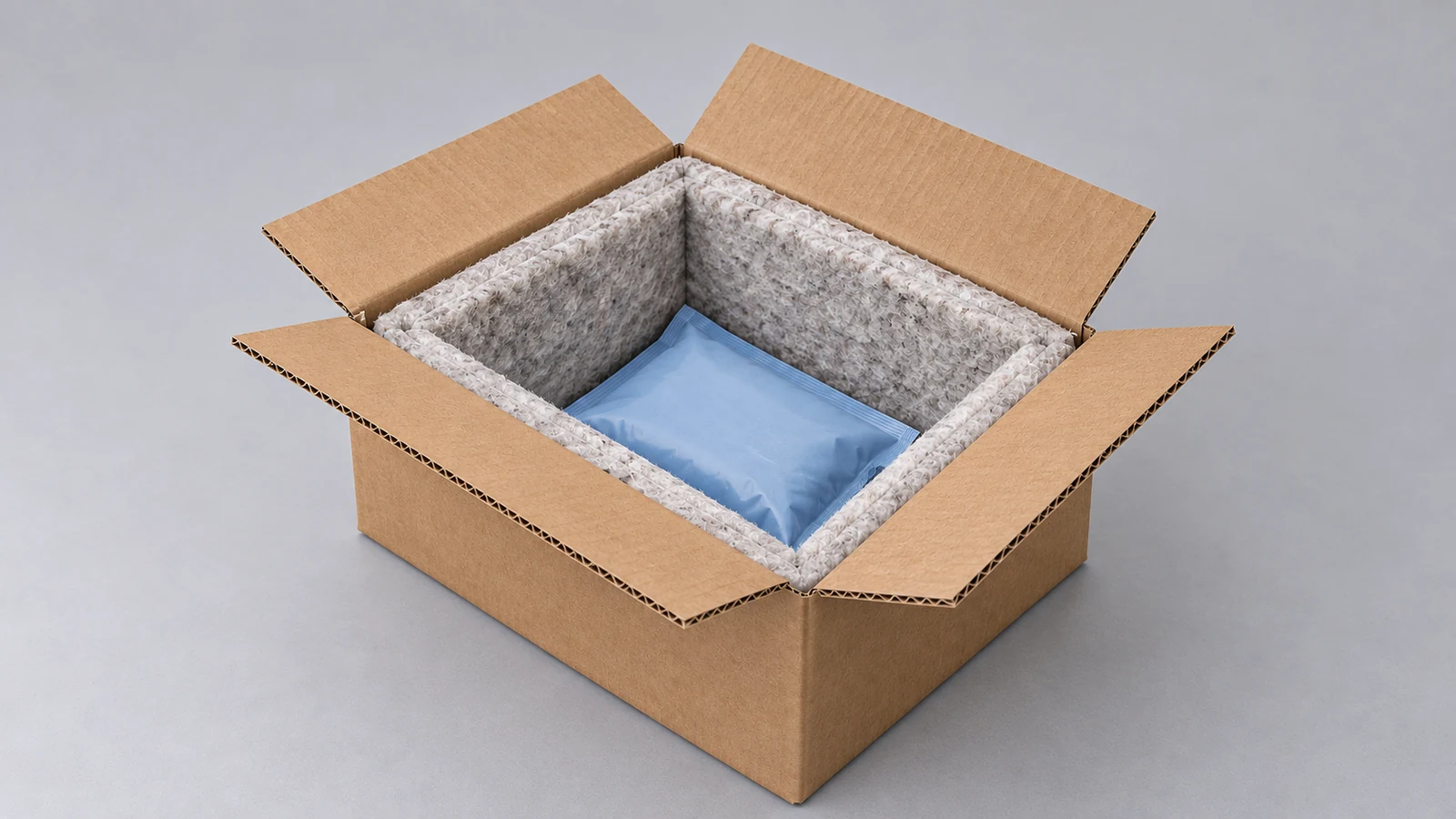
A test duration describes one experiment, not every shipment. Before choosing paper cold-chain packaging, match the complete tested pack-out to your product, temperature limits and transport conditions. Buying the same liner material is not enough.
On 27 October 2026, Packaging Europe reported Hydropac's EcoCool paper-fibre liner, including a supplier-reported 48-hour laboratory trial. This is a useful development in fibre-based shipping packaging, but it is not independent verification of every application, or evidence about YOUNGSUN products.
The practical question is not simply whether paper can insulate. It is whether a documented packaging configuration can keep your particular load within its approved limits through your delivery conditions.
First separate the liner from the complete system
A thermal shipping system combines the outer container, insulation, coolant, payload, closures and preparation instructions. Change one of these and the result may change. ASTM D3103's published scope addresses package thermal performance under variable ambient conditions; its summary identifies insulation, energy sources and payload as relevant factors. The full current method and a suitable laboratory are needed to design a test, not just an online summary.
Ask for the tested construction rather than a material name: box dimensions, insulation thickness, joints, lid coverage, coolant arrangement and loading instructions. A sample of fibrous material cannot establish the performance of an assembled shipper.
Write the route specification before comparing offers
Describe the journey from packing to customer receipt. Include warehouse staging, collection, sorting hubs, vehicle exposure, last-mile delivery and a credible delay scenario. For international shipments, customs or handover time may be relevant. A weather forecast alone does not describe what a parcel experiences inside a hub or vehicle.
Hydropac's own seasonal pack-out guidance highlights route exposure, coolant preparation and configuration. Treat this as manufacturer guidance, not a universal acceptance criterion. Buyers in different climates should not assume a configuration selected for another season or market transfers unchanged.
Define the product's permitted temperature range with your quality team. Include a lower limit where overcooling is a risk and specify how excursions will be assessed. A temperature cited in another company's demonstration is not automatically a safe limit for your food, pharmaceutical or other temperature-sensitive product.
Compare the evidence field by field
| Test record to request | Match it to your shipment |
|---|---|
| Exact box and liner construction | Dimensions, seams, lid and closure used in production |
| Payload identity, mass and starting temperature | Actual product and minimum and maximum order loads |
| Coolant type, quantity, position and conditioning | Instructions your packing team can repeat |
| Ambient temperature profile and duration | Relevant route, season and delay exposure |
| Sensor positions and measurement system | What was measured: air, surface or product temperature |
| Temperature traces and acceptance criteria | Your approved limits, not only a headline pass result |
| Configuration or material changes | Whether the report still applies after the change |
Request the report and temperature trace, not only a marketing chart. Confirm the measurement system's calibration status and whether sensors were located where meaningful product exposure could be detected. Air, product surface and product core readings answer different questions; they should not be silently substituted for one another.
Test the order sizes you actually sell
Minimum-fill and full-load shipments are different configurations. Neither should be declared universally safer without evidence. Payload mass, available space and coolant positioning interact, so your test plan should represent the loads you intend to dispatch.
For example, imagine a nominal two-day delivery service with both a small order and a full carton. One parcel may encounter a warm sorting delay or an unsuccessful first delivery. This is an illustrative planning scenario, not a YOUNGSUN test result. Its purpose is to show why the same delivery promise does not establish identical thermal exposure.
ISTA's thermal standards overview describes qualification frameworks and transport temperature profiles. Ask a competent laboratory which current procedure and profile fit your distribution system. A recognised test method is useful evidence, but naming it does not establish that every route or product is covered.
Check physical protection and moisture separately
Thermal performance is not the same as protection against crushing, vibration or drops. Review the package after relevant handling exposure, and consider condensation, wet surfaces and joint integrity in the test plan. Do not infer mechanical qualification from a temperature report alone. ISTA distinguishes different test procedures; the packaging team should select those appropriate to the shipment.
Likewise, a fibre-based component does not prove that the finished pack is accepted in every local paper collection stream. Check coatings, mixed components, separation instructions and the condition of the used package. Avoid transferring a supplier's environmental claim to a different construction or destination market.
Buy a repeatable pack-out, not just cheaper material
Compare the complete cost per shipment that meets your acceptance criteria: outer box, liner, coolant, assembly, freight and the consequences of rejected deliveries. A lower material price can be misleading if the two quotations assume different coolant quantities or loading methods.
YOUNGSUN can discuss paper components such as kraft paper and PE coated paper for specified wrapping, liner or surface applications. These are not, by themselves, a qualified thermal insulation system. We do not claim to supply EcoCool or to have validated the generic pack shown here.
For a paper-component enquiry, send the intended construction, printing or coating requirements and destination to our team through the quotation enquiry page. Our food and beverage applications and supplier quotation comparison guide can help frame that discussion.
Frequently asked questions
Does a 48-hour test guarantee a 48-hour delivery?
No. It records performance under a particular configuration and exposure. Compare those conditions with your product limits, packing process and route before using the result.
Can ordinary kraft paper replace a thermal liner?
Not on that basis alone. Kraft paper may have a role in a package, but the assembled insulation and coolant system needs evidence for the intended application.
What should we send with a request for quotation?
Send box dimensions, product and load range, approved temperature limits, route and season, expected duration, delay assumptions, coolant constraints and available test requirements. Identify which paper component you want supplied.
Must we review a pack-out after changing coolant or box size?
Yes. Have the packaging or quality team assess whether the existing qualification remains applicable, and determine what additional testing is needed. Do not assume the original report covers the change.