
Beauty & Packaging · 2026-10-12
Paper Cans Can Handle Moisture-Sensitive Products—But Only After These 7 Buyer Tests
A recent fibre-based can trial for bath crystals shows that paper structures are moving into humidity-sensitive categories. For buyers, the opportunity is real—but approval must cover the complete pack, not only its paper percentage or shelf appearance.
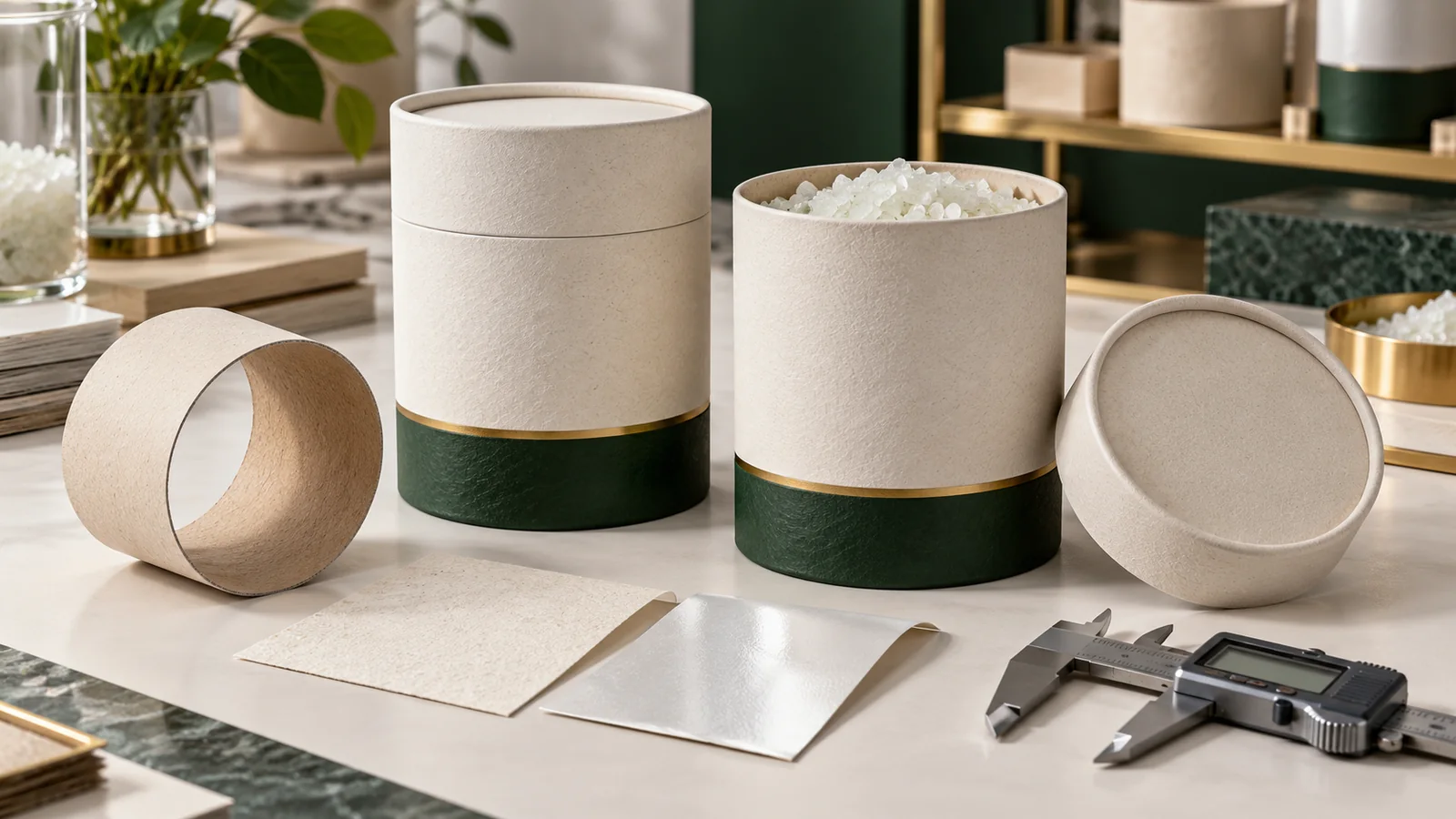
Rigid paper cans are familiar in tea, snacks, powders and premium gifts. Their next challenge is more demanding: products that can clump, lose performance or deteriorate when exposed to humidity.
That challenge returned to the industry spotlight on 9 October 2026, when Packaging Europe reported that Kneipp had introduced a limited-edition bath-crystal product in Sonoco's fibre-based GreenCan format. The article says the pack combines a predominantly paper structure with protection for a moisture-sensitive product and a premium paper-touch finish. Read the Packaging Europe report.
The development matters because beauty and wellness packaging must satisfy several requirements at once: product protection, shelf impact, opening experience, transport strength and a credible end-of-life instruction. Kneipp's own packaging information also makes an important broader point: recycling infrastructure is not equally developed in every market, and there is no single optimal material answer for every format. See Kneipp's packaging approach.
For buyers, the lesson is not that every paper can is ready for every powder. It is that a fibre-based format can only be approved as a complete packaging system. The body, ends, lid, barrier, adhesive, ink, closure and filling process must work together.
Use these seven tests before approving a paper can for bath salts, powdered cosmetics, dry food, nutraceuticals or another moisture-sensitive product.
1. Define the Product's Moisture Risk Before Choosing the Paper
“Moisture-sensitive” is not a specification. Two powders may react very differently under the same storage conditions. One may form small lumps but remain usable; another may lose flow, aroma, potency or appearance.
Start the RFQ with the product, not the container:
- target shelf life and markets;
- expected storage temperature and relative humidity;
- acceptable change in mass, flow or appearance;
- whether the pack will be repeatedly opened in a humid room;
- product fill temperature and residual moisture;
- aroma, oxygen or light sensitivity in addition to water vapour.
The required barrier should be expressed as a measurable target for the finished pack. A water-vapour transmission value for a flat material can help screen options, but it does not represent leakage around seams, ends or the closure.
For initial material selection, compare structural grey board, printable folding box board and coated papers by the role each layer must perform. Do not assume the thickest paper provides the best moisture protection.
2. Request a Complete Layer and Component Map
A paper can is usually a multi-component structure. The visible paper surface may provide print and tactile appeal, while another layer provides stiffness, sealing or barrier performance.
Ask the supplier to identify every component:
| Component | Buyer question |
|---|---|
| Body wall | Which paper or board grades provide stiffness and print surface? |
| Barrier layer | What protects against water vapour, grease, aroma or oxygen? |
| Side seam | How is the overlap sealed and how wide is it? |
| Bottom end | Is it paper, metal or another material, and how is it joined? |
| Lid or plug | Is it reclosable, and what creates the seal? |
| Adhesives and inks | Are they compatible with the product, process and destination market? |
Do not accept “paper-based” as the only construction description. Request material names, basis weights or thicknesses where relevant, and the function of each non-paper layer. This information supports quality control, regulatory review, recycling assessment and repeat-order consistency.
If the pack uses a decorative wrap or label, review label paper and specialty surfaces separately from the structural wall. Appearance material and protective material are not necessarily the same layer.
3. Test Seams, Ends and Reclosure—not Only the Flat Barrier
Many barrier failures occur at interfaces rather than through the centre of the sheet. A strong wall cannot compensate for a poorly sealed bottom, an uneven side seam or a lid that admits humid air after each use.
Evaluate three conditions:
- Unopened pack: Does the sealed container protect the product through production, warehousing and distribution?
- First opening: Does removal of a membrane or plug damage the rim or create loose fibres?
- Repeated use: Does the lid continue to close consistently after multiple opening cycles in a humid environment?
Use dye penetration, vacuum or pressure-decay methods when appropriate, but connect the test to real product ageing. Store filled packs at normal and accelerated humidity conditions, then measure product change and inspect all seams.
For products used in bathrooms or kitchens, include wet-hand handling, condensation and brief splash exposure. These are different from continuous immersion and should be specified separately.
4. Prove Compression, Drop and Dimensional Stability
A cylindrical format may look rigid on a sample table yet deform under pallet load, lose roundness in high humidity or dent during parcel delivery. Distortion can also weaken the lid fit and therefore the moisture seal.
Your validation plan should cover:
- top-load and stacking compression;
- side-impact and edge-crush behaviour;
- filled-pack drop testing in several orientations;
- roundness and diameter after humidity conditioning;
- lid retention after impact;
- pallet vibration and transport simulation;
- performance at the beginning and end of the declared shelf life.
Approve the actual diameter, height, wall construction and fill weight. Results from a smaller or lighter demonstration pack may not transfer to the commercial size.
For premium presentation, the structure may combine a rigid recycled-board core with a printed or textured outer wrap. Our luxury and cosmetics packaging solutions show how structural board, decorative paper and converting requirements should be considered together.
5. Approve Print, Coating and Product Compatibility
Beauty and wellness packs often need saturated colour, tactile coatings, foil, embossing or a soft paper feel. These finishes can change scuff resistance, glue adhesion, odour and the way moisture reaches the structure.
Ask for a printed and converted prototype using the intended production materials. Check:
- colour and shade on the actual paper;
- rub and scratch resistance after filling and transport;
- ink or coating cracking at rolled edges;
- blocking when packed closely or exposed to heat;
- odour transfer to the product;
- compatibility between adhesives, barrier and decorative wrap;
- required chemical, food-contact or cosmetics documentation for the destination market.
Do not describe a whole package as compliant because one paper component has a certificate. Compliance applies to the finished structure, intended product and market. A supplier should provide available declarations and test reports without turning a material characteristic into a legal conclusion.
6. Run the Pack on the Real Filling and Closing Line
A hand-made prototype can hide problems that appear at production speed. Paper cans may behave differently from plastic jars or metal tins during denesting, filling, dust control, membrane sealing, lid placement, coding and case packing.
Plan a line trial that records:
- feeding and orientation stability;
- dimensional tolerances and jam rate;
- dust or loose fibres near the product zone;
- seal temperature, pressure and dwell time;
- closure force and lid consistency;
- print scuffing through guides and conveyors;
- reject rate and inspection method;
- changeover time from the current pack.
Retain filled samples from the beginning, middle and end of the trial. These samples should enter shelf-life, transport and consumer-use testing. A successful empty-container run is not enough.
Before ordering production volumes, use our paper materials library to separate fibre choice, surface performance and converting requirements, then request samples for the intended process.
7. Verify the Recycling Claim in the Destination Market
High paper content can support a fibre-packaging strategy, but percentage alone does not prove recyclability everywhere. Collection rules, sorting equipment, mill acceptance, component separation and local labelling all matter.
Ask five practical questions:
- Which waste stream should consumers use in each target market?
- Must the lid, membrane or bottom be removed first?
- Has the complete printed pack been tested for repulpability or sorting compatibility?
- Which test method, laboratory and pass criteria support the claim?
- Does the disposal instruction match local regulation and infrastructure?
If different components need separation, test whether consumers can do it without tools and without ambiguous instructions. Record the final wording and artwork as part of packaging approval.
The safest claim is specific and evidenced. “Predominantly paper, designed for the paper stream where accepted” may be more accurate than an unconditional global recyclability statement. Legal and environmental claims should be reviewed for each destination market.
Paper Can Packaging RFQ Checklist
Send these details so suppliers evaluate the same commercial requirement:
- product type, composition and moisture sensitivity;
- net fill weight and fill process;
- container diameter, height and target volume;
- target shelf life and destination markets;
- required moisture, oxygen, grease, aroma and light barriers;
- body, end, lid and membrane preferences;
- printing process, colours, finishes and artwork coverage;
- opening, tamper-evidence and reclosure requirements;
- annual quantity and order quantity by size;
- line speed and sealing equipment;
- transport route, pallet pattern and distribution tests;
- required declarations, test reports and recycling evidence.
What This Week's Paper-Can News Really Changes
The Kneipp trial is useful because it brings fibre-based rigid packaging into a category where humidity protection and premium presentation must coexist. It does not eliminate the need for barrier layers or testing. It shows that buyers can explore paper-rich structures beyond conventional secondary cartons—provided the package is engineered and validated as a system.
The practical question is not “Can paper replace this plastic jar?” It is: which paper structure, barrier, closure and approval evidence can protect this exact product through filling, transport, storage and repeated use?
For a new cylindrical pack, gift tube or rigid container, send YOUNGSUN PAPER the product, size, board requirement, print finish, quantity and destination market. We can help arrange structural and decorative paper samples for printing and converting trials. Barrier performance and final-pack compliance must be confirmed with the selected converter and test laboratory.
Frequently Asked Questions
Can a paper can protect moisture-sensitive powder?
It can when the complete structure provides the required barrier and seal integrity. Approval should use filled-pack ageing, seam, closure, transport and repeated-opening tests—not only a flat paper sample.
Does thicker paper automatically improve moisture barrier?
No. Thickness and stiffness mainly support structure. Moisture performance depends on the barrier layer, seams, ends, closure and exposure conditions.
Is a high paper percentage enough to call the pack recyclable?
No. The complete printed package should be assessed against the collection, sorting and recycling conditions of each target market, including any component-separation instructions.
Which sample should buyers approve before mass production?
Approve a printed, converted and filled production-line sample using the intended body, barrier, ends, lid, inks and adhesives. Retain a signed master sample and the supporting test record.