
Guides · 2026-07-24
Custom Paper Sizes and Slitting: How to Minimize Waste and Save Money on Every Order
Standard paper sizes waste material. Custom slitting and sheeting to your exact converting dimensions eliminates trim waste, reduces per-unit cost, and simplifies your production — with surprisingly low MOQs.
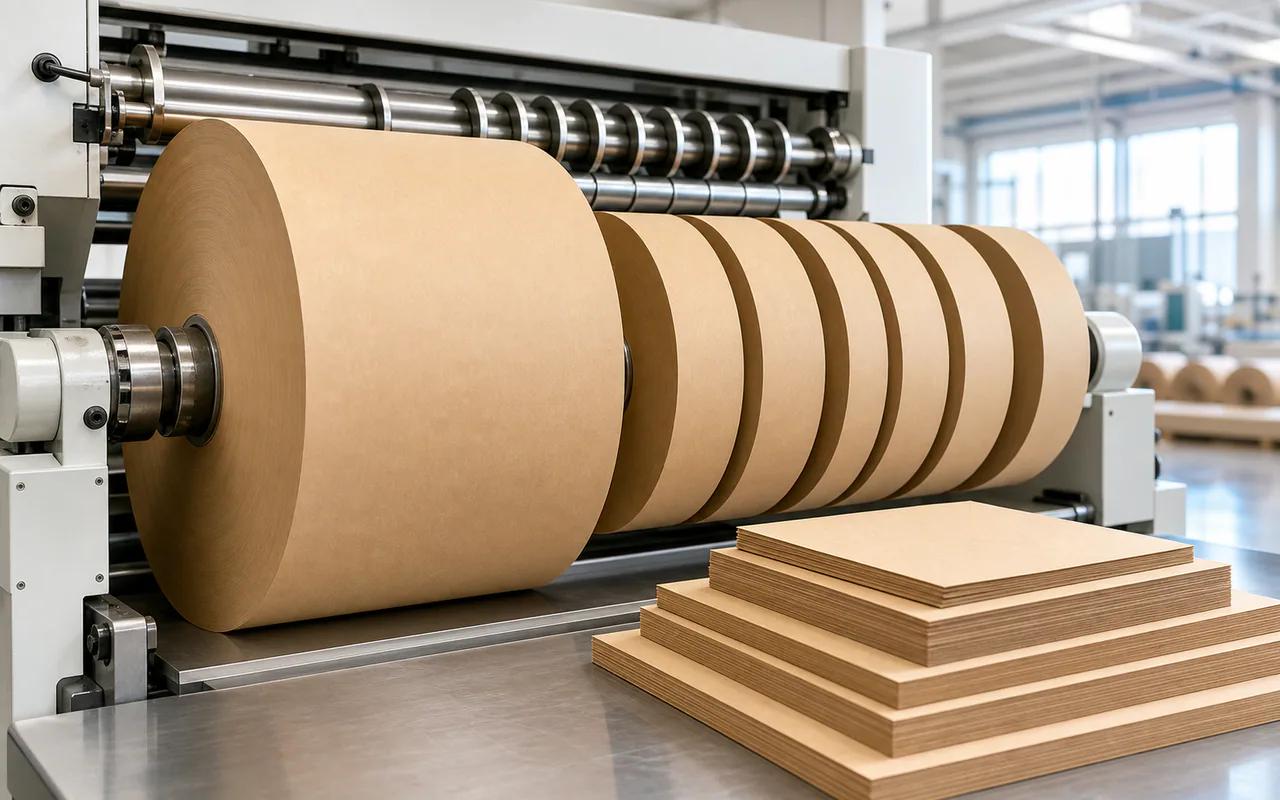
Standard sheet sizes exist for a reason — they're efficient for mills to produce and easy for distributors to stock. But if your end product doesn't align neatly with 787×1092mm or 889×1194mm, you're paying for paper that goes straight to the recycling bin.
Custom slitting and sheeting are among the most underutilized cost-reduction tools in paper buying. This guide explains how they work and how to calculate whether custom sizes will save you money.
The Hidden Cost of Standard Sizes
Example: Box manufacturer using 787×1092mm sheets
- Sheet area: 787 × 1092 = 0.859 m²
- Box blank layout (after nesting): uses 0.645 m² per sheet
- Usable area: 0.645 / 0.859 = 75.1%
- Trim waste: 24.9%
With a custom sheet size of 680×950mm:
- Sheet area: 680 × 950 = 0.646 m²
- Box blank layout: uses 0.640 m²
- Usable area: 0.640 / 0.646 = 99.1%
- Trim waste: 0.9% — a 96% reduction in waste
Annual savings at 200 tons/year, $700/ton:
- Before: 200 tons with 25% waste = 150 usable tons
- After: 154 tons with 1% waste = 152 usable tons (same output, 23% less paper purchased)
- Savings: $32,200 per year
How Custom Sizing Works
Custom Sheet Sizes
Sheets are cut to your exact width × length from master rolls or sheets.
- Tolerance: ±1 mm (standard), ±0.5 mm (precision)
- Min size: ~300×400 mm (smaller sizes generate more handling cost)
- Max size: Up to 1200×1600 mm (depending on base sheet)
- MOQ: Typically 1 metric ton per size
Custom Reel/Roll Slitting
Master rolls slit to your exact width and diameter.
- Tolerance: ±0.5 mm on width
- Min slit width: 15 mm
- Max roll diameter: 1,200 mm (depending on grade)
- Core sizes: 3", 6", 12" or custom
- MOQ: Typically 500 kg per width
When Custom Sizes Make Sense
✅ High-volume production — Even 5% waste reduction on 100+ tons/year pays back quickly. ✅ Non-standard box formats — Unusual aspect ratios waste more on standard sheets. ✅ Multiple SKUs from one sheet — Custom sheet optimizes nesting of different box layouts. ✅ Web-fed converting — Custom reel width eliminates edge trim on bag machines, flexo presses. ✅ Just-in-time delivery — Less waste = less inventory = less warehouse space.
❌ Small trial orders — The MOQ (1 ton) may exceed your needs. Use standard sizes for samples. ❌ Standard box formats — If your layout fits 787×1092mm efficiently, don't over-optimize.
How to Calculate Whether Custom Sizes Pay Off
Step 1: Calculate Current Waste Rate
``` Waste % = (Sheet area - Used area) / Sheet area × 100 ```
Step 2: Calculate Annual Waste Cost
``` Waste cost = Annual tonnage × Waste % × Price per ton ```
Step 3: Compare to Custom Size Scenario
``` Custom sheet area needed = Used area + 1% handling waste New annual tonnage = Old tonnage × (Custom area / Standard area) Savings = (Old tonnage - New tonnage) × Price per ton ```
Step 4: Compare to MOQ and Premium
Custom sizes may carry a small premium (5–10% on small orders). Factor this in:
``` Net savings = Material savings - Custom cutting premium ```
If net savings > $500–1,000/year, it's worth doing.
Slitting Specifications: How to Write a Good One
A clear slitting specification prevents disputes:
``` Product: 300 gsm FBB Format: Reels Width: 850 mm ±0.5 mm Max roll diameter: 1,100 mm Core: 6 inch (152 mm) Winding direction: Print side out Slitting quality: Clean cut, no dust, no edge burr Packing: PE-wrapped, palletized, desiccant included ```
Common Pitfalls
- Not accounting for grain direction — Sheets cut from reels have grain parallel to the long edge. If your application needs grain the other way, specify it.
- Ignoring cutting dust — Slitting generates paper dust. Specify "dust extraction during slitting" for clean-room applications.
- Over-optimizing — If the savings is $200/year on a $50,000 order, the complexity isn't worth it. Only optimize when savings exceed $500/year.
- Skipping the trial — Always order 1 ton of the custom size as a trial before committing to volume.
YOUNGSUN Custom Sizing Capabilities
| Service | Specs | MOQ | Lead Time |
|---|---|---|---|
| Custom sheet cutting | ±1 mm tolerance | 1 ton/size | +1–2 days |
| Precision sheet cutting | ±0.5 mm tolerance | 2 tons/size | +2–3 days |
| Reel slitting | ±0.5 mm width tolerance | 500 kg/width | +1–2 days |
| Square-cut sheets | 90° ±0.1° | 1 ton/size | +1–2 days |
The Bottom Line
If you're buying more than 50 tons per year and your current sheet utilization is below 85%, custom sizes will almost certainly save you money. The math is simple — the only question is whether the savings justify the slightly higher per-ton price and the planning discipline of ordering to your exact specification.
Contact us with your current sheet size, box layout dimensions, and annual volume. We'll calculate your waste rate and recommend the optimal custom size.