
Packaging · 2026-07-24
Grey Board, Duplex or FBB: Compare the Finished Pack
Compare the complete construction, not just the paper price. This guide separates rigid-core requirements from folding-carton needs and provides a repeatable approval and quotation checklist.
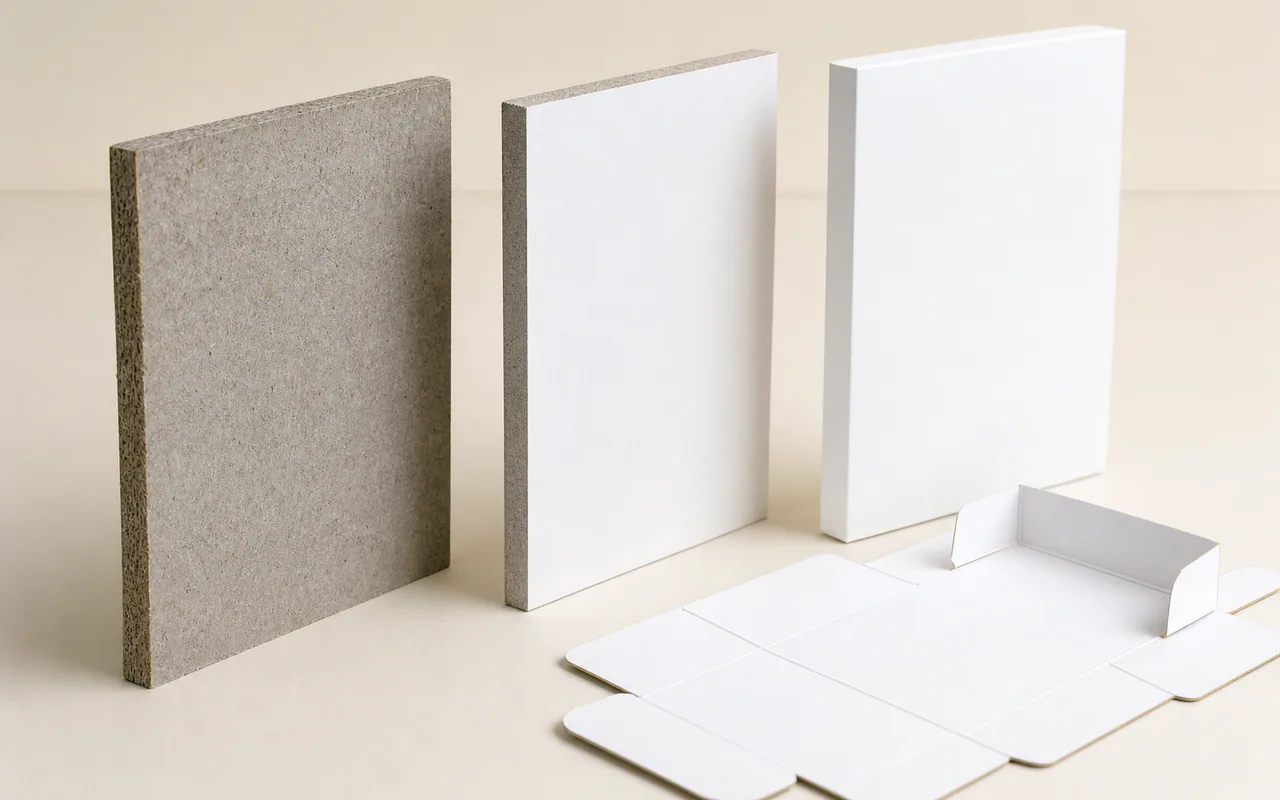
The practical choice between grey board, duplex board and FBB starts with the finished packaging. Identify structural role, visible surfaces, converting process and product-protection requirements before comparing grades.
A rigid wrapped box and a directly printed folding carton have different bills of materials and production routes. Price per tonne, GSM or a generic “premium” label cannot compare those systems by itself.
A three-route decision matrix
| Route | Initial material candidate | What to approve |
|---|---|---|
| Wrapped rigid shell or mounted cover | Grey board with a separate visible wrap | Caliper, dimensions, flatness, bonding and assembled stiffness |
| Directly printed folding carton | A suitable duplex or FBB grade | Printing face and reverse, grain direction, crease, fold and glue performance |
| Carton with demanding presentation or weight targets | Compare specific FBB and other suitable cartonboard grades | Print result, caliper, stiffness, converting yield and protection at the chosen weight |
Use this matrix to shortlist candidates. It does not assign one board permanently to a market sector or guarantee that a lighter construction will pass the same tests.
FBB does not always mean two coated printing sides
Confirm coating and reverse specifications. For example, Stora Enso's Performa range includes one-side coated GC2 and GC1 with a white-coated reverse. This illustrates variation between grades; it is not a claim that YOUNGSUN supplies that particular branded product.
If printing both sides matters, send the inside artwork as well as the outside. Approve colour, drying, rub and finishing on both actual surfaces. Do not substitute an FBB category name for a two-sided print specification.
GSM, caliper and stiffness are separate inputs
Request the exact grade and its available technical data. A supplier data sheet may report GSM, caliper and directional stiffness separately, as shown in Holmen's Incada Exel data. Those values describe that product, not all FBB or another supplier's board.
Avoid a universal stiffness ranking between grey board, duplex and FBB. Compare like test methods, relevant directions and agreed conditioning, followed by a converted prototype. Finished geometry and joints can change performance even when the sheet data appear similar.
Prove the converting route on the intended equipment
The Holmen guide to creasing and folding explains that tooling geometry, board structure and fibre direction contribute to the result. A product family does not guarantee crack-free folds at a stated machine speed.
Record the real die line, rule/channel setup, grain direction, print coverage, coating and adhesive. During a representative trial, measure stoppages, rejects and finished-pack defects. Set acceptance criteria with the converter rather than copying another brand's claimed throughput or reject rate.
Compare quotations on a common basis
Remove generic dollar-per-tonne rankings from the decision. A valid quote comparison needs the same grade basis, quantity, format, trade term, named destination and validity date. CIF figures for different ports or dates are not directly comparable.
For a rigid route include core board, wrap, adhesive, cutting, assembly and rejects. For a carton route include board, printing, plates/tooling, die-cutting, folding, gluing and line losses. Then compare the agreed finished-pack output and protection requirement.
An internal comparison can use total agreed production cost divided by accepted finished packs. State what the cost includes and record waste rather than assuming a fixed yield. This is a purchasing method, not a YOUNGSUN quotation or a promised saving.
Verify sustainability claims independently
Request the actual fibre declaration, relevant FSC transaction claim and any product-specific environmental data. Do not infer that a grade is 100% post-consumer, has the lowest carbon footprint or will be recyclable everywhere from its colour or board family.
FSC distinguishes its labels by material sourcing, not by the strength or total environmental impact of a package. Carbon comparisons require a consistent assessment basis, while recycling depends on the converted construction and destination system. Food-contact suitability requires its own assessment.
A practical approval sequence
- Define the finished pack, print surfaces, product load and use conditions.
- Shortlist exact grades and request available technical data and representative sheets.
- Produce the real converted structure with the intended wrap, ink, coating and adhesive.
- Assess appearance, dimensions, rigidity, folding, bonding and any relevant transport or use tests.
- Compare quotations for the accepted construction and record the reference sample and substitution rules.
For a focused two-material discussion, see grey board versus duplex for wrapped and printed construction. Send your drawing and proposed specification for sample selection, or explore packaging and printing applications. Standard samples are free; international courier charges are paid by the customer. Sample availability and dispatch are agreed for the request rather than promised within a universal number of days.
Frequently asked questions
Is FBB always the best board for a premium pack?
No. The construction and visual effect matter. A wrapped rigid box may use a grey-board core, while a folding carton may use FBB or another suitable grade. Approve the result rather than the category label.
Can I choose the cheapest quote per tonne?
First align specification, format, trade term and date. Then include converting and accepted output. Lower paper price does not automatically mean lower finished-pack cost.
Does virgin fibre automatically make a board food-safe?
No. Match the exact composition and complete structure to the intended food and use conditions, supported by applicable documentation.
Can I rely on the machine speed quoted in an example?
Only if it is relevant, documented and representative of your setup. A generic example is not evidence of your line's speed, yield or defect rate.