
Food Packaging & Barrier Paper · 2026-10-20
85% Paper Sounds Freezer-Ready—What Must an Ice Cream Wrapper Prove?
A new paper-dominant ice cream wrapper is drawing attention, but paper percentage is only the starting point. Buyers still need to prove cold-chain barrier, seal integrity, machine performance and the exact end-of-life claim.
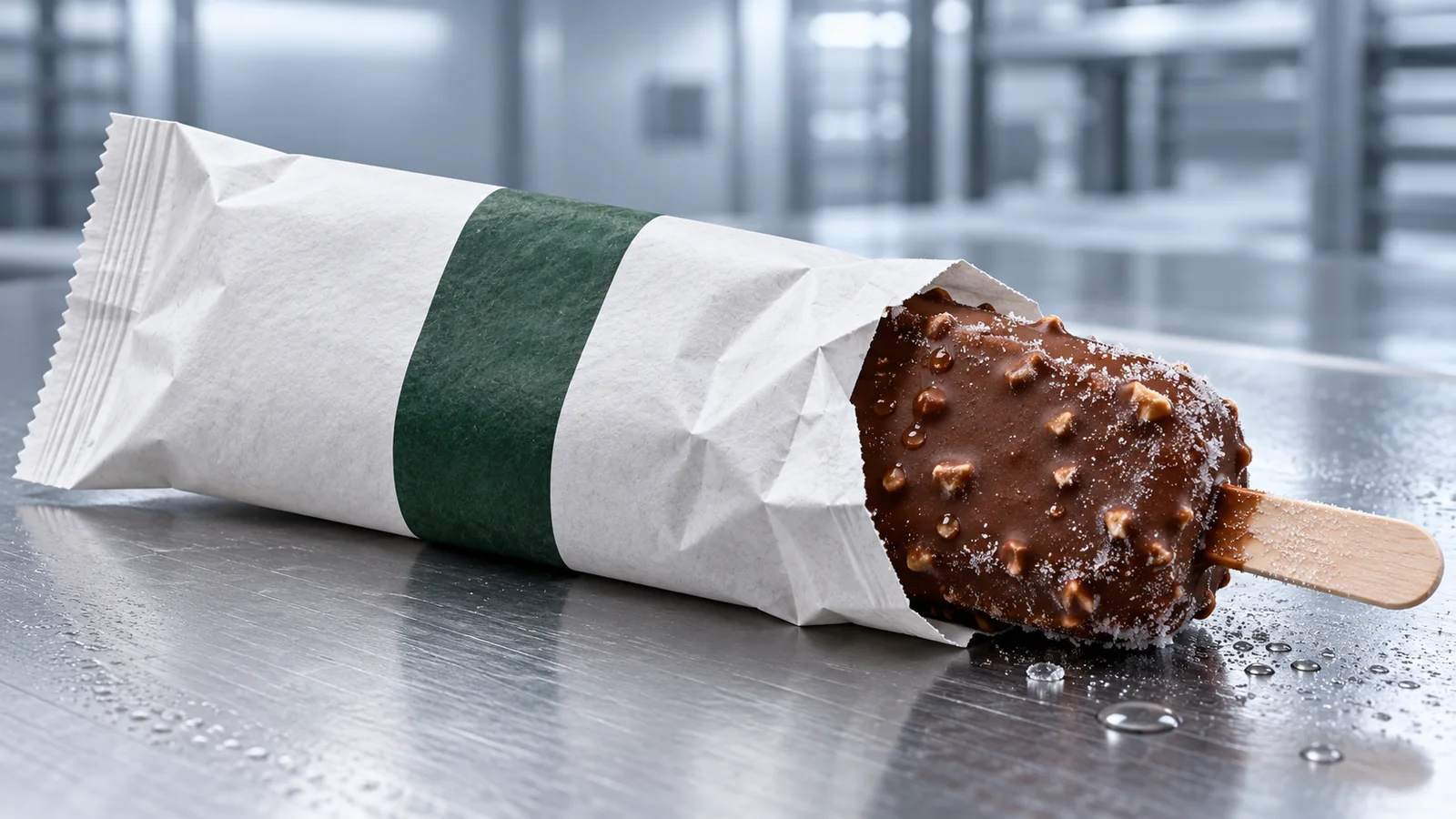
An ice cream wrapper can look convincingly like paper and still fail where it matters: at the seal, inside the freezer, on a wet distribution case or at full production speed. That is why a headline paper percentage is useful context, but not a complete purchasing specification.
The topic is timely. Tetra Pak recently announced an ice cream wrap made with up to 85% paper, a paper-based barrier and other protective layers. The company says the structure is being validated with European producers before a phased rollout. Read Tetra Pak's announcement. At PACK EXPO International 2026, paper-based flexible structures, heat-seal coatings and cup barriers are also being discussed as connected systems rather than single sheets. See the PACK EXPO paper-coating session overview.
For buyers, the useful question is not “How much paper is in it?” It is: Can the complete printed, sealed and filled structure protect the product through production, frozen storage, distribution and disposal in the target market?
This guide turns that question into eight approval gates. It is a procurement framework, not a claim that every paper grade or coating suits direct frozen-food contact.
1. Define the Complete Structure, Not Only the Paper Percentage
“Up to 85% paper” describes material composition, not every functional layer. The remaining share may include polymers, inks, lacquer, adhesives or other components needed for barrier, sealing and print performance.
Ask the supplier or converter for a layer-by-layer description:
- base paper type and grammage;
- paper-based, polymeric or dispersion barrier;
- food-contact side and print side;
- heat-seal layer or lacquer;
- ink and overprint varnish system;
- adhesive, primer or tie layer;
- total structure grammage and thickness;
- percentage calculation method and supporting document.
A base paper certificate does not automatically cover the finished wrapper. Approval must apply to the complete commercial structure.
2. Test Water Vapour and Product-Specific Barrier
Frozen products experience long storage periods and repeated temperature changes. Moisture can move through the wrapper, condense on its surface or affect the product after a partial thaw-and-refreeze event.
Define the real protection target before choosing a material:
- storage temperature and expected shelf life;
- water-vapour barrier requirement;
- fat or oil resistance from the product and inclusions;
- aroma retention and odour transfer;
- light or oxygen protection when formulation requires it;
- resistance to condensation outside the pack.
Do not approve a general “moisture resistant” statement. Request the test method, units, conditions and result for the exact structure. A barrier value measured at one temperature and humidity may not predict freezer performance by itself.
3. Prove the Seal After Freezing, Flexing and Contamination
The seal is often the most vulnerable part of a flexible paper pack. It must form at production speed, tolerate variation in jaw temperature and pressure, and stay closed when the material becomes cold and less flexible.
Build a seal-window trial that records:
- minimum and maximum sealing temperature;
- dwell time and line speed;
- pressure and jaw pattern;
- seal strength before and after freezing;
- performance when a small amount of ice cream, fat or frost reaches the seal area;
- leak or peel behaviour after transport vibration.
Test easy opening and package integrity together. A wrapper that opens beautifully but leaks during distribution is not ready; a seal that survives transport but tears the product apart at opening is not ready either.
4. Run Cold-Flex and Crack-Resistance Tests
Paper fibres, coatings and printed layers can respond differently at low temperature. Folding and impact may create microcracks that are invisible when the pack leaves the machine.
Condition filled packs at the target storage temperature, then flex, drop and handle them as the distribution chain will. Inspect:
- fold and crimp areas;
- corners and end seals;
- pinholes or coating cracks;
- delamination;
- fibre break or whitening;
- loss of print or varnish adhesion.
Repeat the inspection after controlled temperature cycling. The test should reflect a realistic route from production freezer to warehouse, truck, retail cabinet and consumer handling.
5. Confirm Machine Performance at Commercial Speed
A laboratory sheet can pass barrier testing and still fail on a flow-wrapper. Paper-dominant structures may have different stiffness, friction, curl, static and tear behaviour from the plastic structure they replace.
During the line trial, record:
- unwind and web-guiding stability;
- tension range;
- registration accuracy;
- cutting and tear initiation;
- dust or fibre generation;
- crimp formation and seal consistency;
- reject rate during start-up and sustained speed;
- changeover settings and operator interventions.
The approval run should be long enough to expose roll changes, splice behaviour and temperature drift. A short demonstration at reduced speed is not a production qualification.
6. Validate Print, Rub and Condensation Resistance
Frozen packs encounter wet hands, cold display cases and abrasion against neighbouring products. Approve the graphics after printing, sealing and conditioning—not from the artwork or an unfrozen proof.
Check:
- colour on the selected paper shade;
- ink adhesion after freezing;
- wet rub and dry rub resistance;
- scuffing at folds and crimps;
- barcode and date-code readability;
- varnish or coating haze after condensation;
- blocking between stacked or rolled surfaces.
If a variable code is added on the packing line, test it at actual speed and after frozen storage. The paper surface, topcoat and condensation conditions all influence code quality.
7. Match Food-Contact Evidence to the Exact Wrapper
EU food-contact rules require packaging materials not to transfer substances to food in amounts that endanger health, unacceptably change composition or affect taste and odour. They also require traceability and good manufacturing practice. Review the European Commission's food-packaging overview and its food-contact materials resources.
For the destination market, ask for evidence covering:
- the complete multilayer construction;
- intended food type, contact time and temperature;
- direct or indirect contact side;
- migration and sensory testing where applicable;
- ink, coating, adhesive and barrier components;
- manufacturing site and current formulation;
- declaration of compliance and supporting reports.
Do not reuse a report for a different coating weight, adhesive, ink system or supplier without confirming that it remains applicable.
8. Separate “Paper-Based” from “Recyclable in My Market”
A high paper share can support a fibre-based design, but it does not by itself prove collection, sorting or recycling in every country. Tetra Pak's product information qualifies recyclability according to the availability of suitable collection, sorting and recycling infrastructure. That wording matters.
Before approving an environmental claim, confirm:
- the classification method for the finished structure;
- whether the barrier separates or disperses during repulping;
- fibre yield and reject level from the applicable test;
- accepted collection route in each sales market;
- local labelling and EPR requirements;
- whether inks, coatings and product residue change the result;
- evidence supporting any “recyclable,” “paper-based” or “plastic-free” claim.
The EU Packaging and Packaging Waste Regulation covers packaging of every material and introduces design, labelling and waste-management requirements on a phased timetable. Use the European Commission's PPWR implementation page for current guidance and dates. Market-specific legal review remains the brand owner's responsibility.
Buyer Approval Matrix
| Approval gate | Minimum evidence | Failure to watch for |
|---|---|---|
| Structure | Layer list, total GSM/caliper, composition method | Paper percentage hides an unsuitable barrier or seal layer |
| Barrier | Test method, conditions and target shelf life | Moisture gain, odour loss or fat staining |
| Seal | Seal window and frozen seal-strength data | Leaks, channel seals or difficult opening |
| Cold chain | Filled-pack freeze, flex, drop and cycle tests | Cracking, pinholes or delamination |
| Machine | Commercial-speed line trial | Curl, web breaks, poor registration or high rejects |
| Wet/dry rub, condensation and code checks | Scuffing, haze or unreadable codes | |
| Food contact | Documents for the final structure and intended use | Report covers only base paper or wrong conditions |
| End of life | Applicable recyclability test and market route | Claim is not valid where the pack is sold |
What to Include in an RFQ
Send enough information for the material supplier, converter and packer to evaluate the same application:
- ice cream format, dimensions and fill weight;
- stick, sandwich, cone, bar or other pack style;
- direct-contact surface and product formulation;
- target shelf life and cold-chain temperatures;
- barrier and seal requirements;
- printing method, colours and variable coding;
- packaging machine model and target speed;
- roll width, core, diameter and splice requirements;
- destination countries and required food-contact documents;
- environmental claim that the brand intends to make;
- annual volume, trial quantity and launch timing.
YOUNGSUN PAPER can help buyers compare potential paper bases and barrier-paper families for converter trials, including greaseproof paper, PE coated paper, MG paper and other food-packaging grades. Final suitability depends on the complete converted structure and application. Standard samples are free; the customer pays international courier charges. Request a material discussion and samples or review our food and beverage packaging solutions.
Frequently Asked Questions
Does 85% paper mean the wrapper is recyclable everywhere?
No. Paper share is only one input. Recyclability depends on the complete structure, testing method, fibre recovery, coatings, contamination and the collection and recycling system in the market where the pack is sold.
Can ordinary greaseproof paper wrap ice cream by itself?
Not automatically. Grease resistance does not prove water-vapour barrier, heat sealability, frozen flex performance or shelf life. The base paper and every coating or sealing layer must be engineered and tested as a complete package.
Which sample should a buyer approve?
Approve a filled, printed and sealed pack produced on the intended line, then tested through the expected cold chain. Keep the signed sample, structure revision, test reports and machine settings under change control.
Is a supplier declaration enough for food contact?
It is part of the file, but buyers should also verify scope, formulation, intended food, temperature, contact time and supporting reports required by the destination market. The documents must match the final wrapper, not only the base paper.