
Packaging Design & Procurement · 2026-10-30
Moulded Fibre or Paperboard Inserts? The Choice Hidden Inside the Box
A natural-looking tray and a crisp folded insert may both fit the same gift box. That does not mean they restrain the product, assemble or travel in the same way.
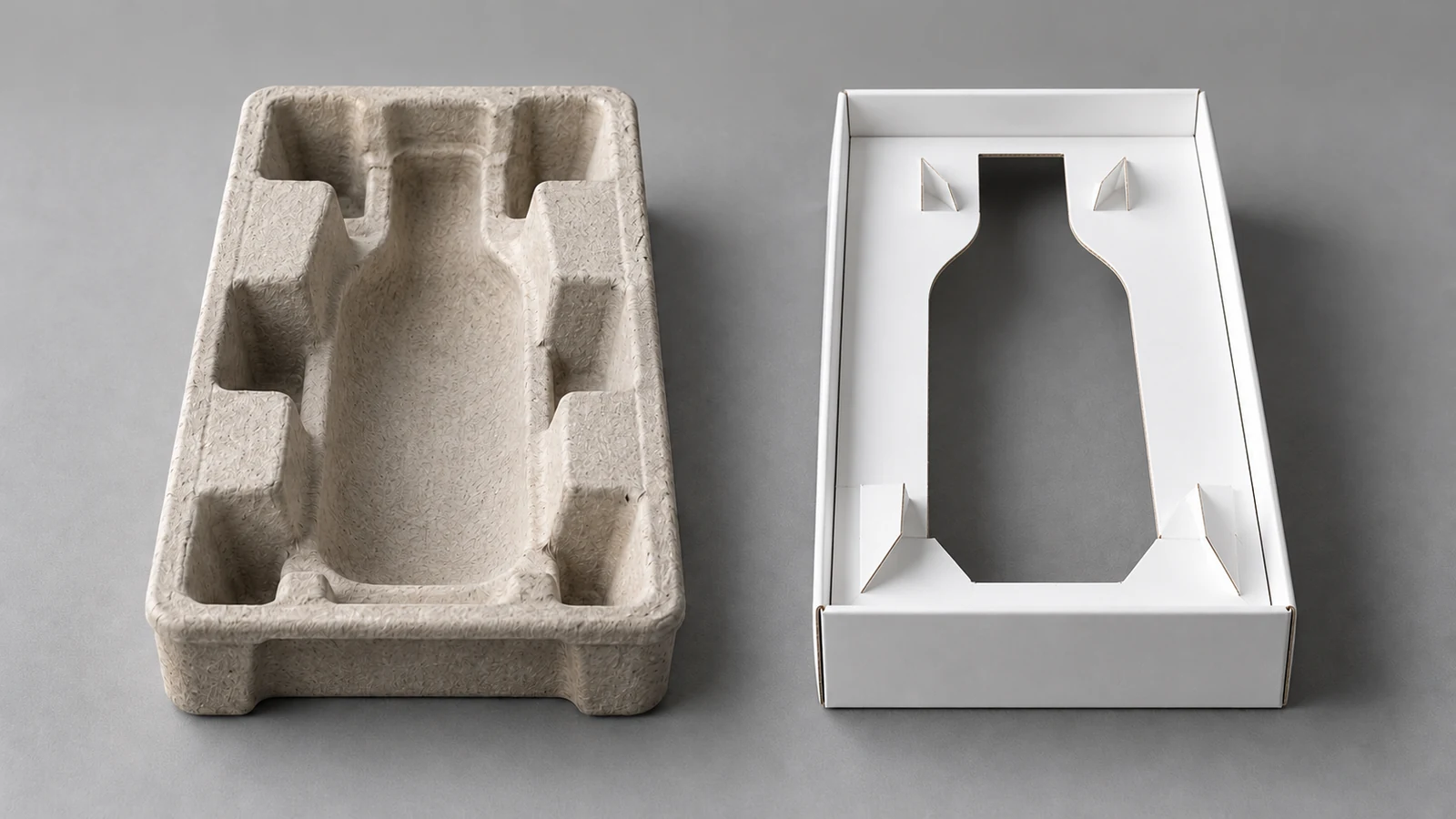
Choose the insert by what it must hold and survive, not by its material name alone. A moulded fibre tray and a die-cut paperboard insert can create very different load paths, assembly steps and presentation effects inside an otherwise identical box. Neither is automatically the better purchase.
The question is timely. In a 30 October 2026 Packaging Europe interview, Z1RO discussed non-wood biomass for moulded packaging and the move towards industrial validation. Its own website describes the development of packaging from underused bio-residues. These are company-specific developments, not proof that any natural-looking insert has equivalent performance or environmental benefits.
For a buyer of cosmetic, electronics or premium gift packaging, the useful decision starts one level earlier: what should the insert actually do for this product?
Define the job before requesting a material
Write down the product's dimensions, weight and acceptable contact areas. Identify fragile necks, pumps, decorative surfaces, screens or loose accessories. Then describe how the customer should remove the product. A tight fit that scratches a finish or makes removal difficult is not a successful presentation.
Separate display requirements from transport requirements. A retail gift box carried home and a single parcel shipped through a delivery network may need different protection, even when their outer dimensions match. Explain whether the gift box is shipped inside an additional protective carton.
An illustrative brief might be a cosmetic bottle and its accessory in a rigid presentation box. Define which surfaces may touch the insert, how the accessory is restrained and what constitutes unacceptable movement or marking. Do not start by copying an attractive tray from a photograph and asking only for its thickness.
Understand the two structural routes
A moulded fibre insert is formed into a three-dimensional part. Its cavity, ribs, wall geometry and surface finish are part of the design. A folded paperboard insert starts with a sheet cut and creased into a structure; openings, tabs, folds and supports determine how it locates the product.
Both routes still require an actual prototype. A deep cavity does not by itself prove cushioning, and a thick sheet does not by itself prove transit protection. Ask where the product is supported and where loads are transferred to the outer package.
Holmen's paperboard creasing and folding guidance explains that folding depends on a deliberately formed crease. For a converted insert, confirm the selected board, caliper and crease design with the converter rather than assuming all boards fold alike. A layout approved on one stock should be reviewed when that stock changes.
Compare the complete design, not two loose samples
| Decision point | Moulded fibre route | Die-cut paperboard route |
|---|---|---|
| Product location | Review cavity geometry and contact surfaces | Review openings, supports and folded tabs |
| Appearance | Assess texture, edges and visible fibre variation | Assess print, cut edges, creases and exposed surfaces |
| Repeatability | Agree part dimensions, tolerances and material revision | Agree stock, caliper, dieline and converting settings |
| Packing operation | Trial loading, removal and nesting where applicable | Trial folding, locking or gluing and loading |
| Design changes | Ask what requires revised tooling or qualification | Ask what requires a revised dieline, tool or trial |
| Shipping evidence | Test the specified part inside the complete pack | Test the specified insert inside the complete pack |
This is a checklist for quotations, not a claim that one route always needs more tooling, occupies less space or costs less. Obtain the supplier's actual assumptions for each design.
Make protection measurable before the trial
Agree acceptance criteria with the brand and packaging team: product breakage, surface marking, movement, loose accessories and permitted package deformation. The acceptable result for an internal support may differ from that for a visible premium surface.
ISTA's design and testing guidance stresses representative samples and defined damage criteria. Its test procedure overview distinguishes different distribution environments. Have a competent packaging team or laboratory choose the current test appropriate to your shipment; do not apply a convenient test name without checking its scope.
Use the intended product, insert, box, closures and outer shipper where applicable. Record the material version and packing method. A test on an empty tray or a different bottle does not establish the result for your finished pack. If storage or distribution involves relevant humidity or other conditioning, agree how that is represented rather than making up a universal requirement.
Specify paperboard components without confusing their roles
Grey board may be considered for rigid supporting structures, subject to the design and converting process. Folding box board may be evaluated for printable folded components. Black paper may provide a visible decorative surface or form part of a specified construction. The required grade and caliper depend on that role.
Do not treat a decorative facing as a substitute for a structural support, or specify grey board as though every grade behaves like folding carton board. Tell the supplier whether you need the base sheet, a laminated structure, cut components or another agreed converting scope. Material suitability is established through specification and samples, not through these general examples alone.
Read the cost and environmental comparison carefully
Compare material or part price together with tooling, packing labour, inbound volume, storage, rejects and any outer packaging changes. State the order quantity, expected repeat orders and ownership of tooling. A quotation for flat blanks is not directly comparable with one for ready-to-load parts unless the remaining work is included.
Likewise, non-wood, recycled, paper-based and recyclable describe different things. Ask for composition, coatings or binders, supporting documents and the destination's available collection route. A supplier's carbon figure for a specific design cannot be transferred to your own insert without a relevant comparison. Natural texture alone is not environmental evidence.
Send one brief to both suppliers
Include the product drawing, contact restrictions, outer pack dimensions, loading and removal sequence, appearance requirements, destination and test expectations. Ask each supplier to list assumptions and exclusions. Then compare approved prototypes rather than comparing a render with a production sample.
For a paperboard-component project, contact YOUNGSUN with your intended structure and review our luxury and cosmetics applications. Our paper quotation comparison guide helps organise the commercial details. This article does not claim that YOUNGSUN manufactures Z1RO materials, supplies the pictured prototypes or has validated their protective performance.
Frequently asked questions
Is moulded fibre always more protective than a paperboard insert?
No. Protection depends on the product, geometry and complete pack. Compare representative prototypes against agreed damage criteria rather than selecting by material name alone.
Can black paper replace a structural insert?
Not automatically. Determine whether it is a decorative facing or a structural component and confirm the exact grade, construction and trial result.
Should we compare cost per tonne or cost per insert?
Use a common finished-pack scope. Include the remaining converting and assembly work, tooling, logistics and acceptance requirements so the two quotations represent the same job.
Does a non-wood fibre insert prove that the pack is recyclable?
No. Feedstock is only one detail. Review the finished construction, other components and the collection and recycling route relevant to the destination market.