
Food Packaging · 2026-11-25
Paper Yogurt Packaging: The Lid Changes the Buying Decision
A paperboard pot and a convenient lid are not yet an approved dairy package. Define what happens during sealing, transport, first opening and later handling before asking for an equivalent material.
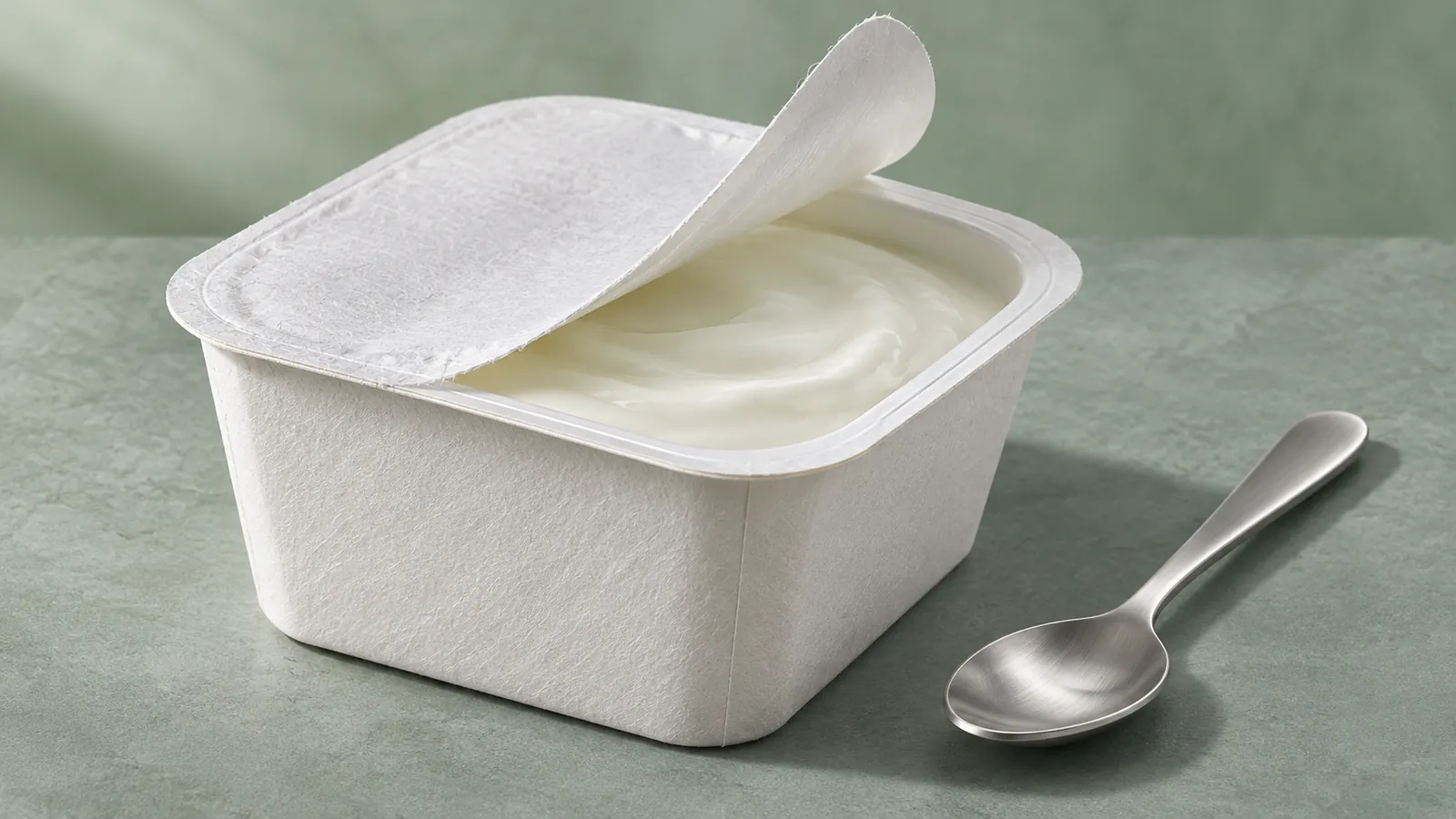
Buy paper yogurt packaging as a complete food-packaging system, not as a board GSM plus a lid. Before comparing quotations, define the product, filling route, barrier, seal and intended opening experience. A change at the top of the pack can require a different approval decision even when the body looks familiar.
The question is timely: Packaging Europe reported Tetra Reva on 24 November 2026, followed by Packaging Insights coverage on 25 November. In its own announcement, Tetra Pak describes a paper-based format for spoonable foods, with a wide opening and a pull-ring lid. The procurement lesson is broader than that branded system: specify how the consumer accesses the food, not only what the empty container is made from.
This guide is an independent buyer framework. YOUNGSUN PAPER is not claiming to manufacture Tetra Reva, supply its proprietary materials or provide a substitute approved for its filling equipment. The cover is a generic concept, not an image of that package.
Start with the opening the buyer actually needs
A spoonable yogurt, a drinkable fermented product and a soft cheese do not necessarily share an opening brief. Define whether the consumer needs a small access point or a wide top, whether pieces must pass through it, and whether the contents are eaten in one occasion. Describe the intended action in the RFQ: grip, lift, peel, remove, spoon and, if applicable, replace the lid.
Tetra Pak's package page illustrates why this matters: it distinguishes full-top and curved openings, including different attached and removable lid options. Those are choices within a particular system, not evidence that an arbitrary paperboard and closure can be interchanged.
For an independent development project, ask the package designer and closure supplier to define the rim or flange, lid contact area, opening direction and allowed deformation. Evaluate whether the body can be held while the opening is operated. An attractive empty mock-up answers a different question from a filled package opened after distribution.
Separate the four things hidden inside one quotation
Use four lines in the specification rather than a single phrase such as food-grade paper pot. The table below is our suggested division of responsibility; it is not a certification or a standard test method.
| Part of the purchase | Information to request | What it does not establish on its own |
|---|---|---|
| Paperboard body | Exact grade, GSM and caliper, forming route, dimensions and available technical data | Finished-package barrier, sealing or shelf life |
| Food-contact and barrier structure | Full layer construction, contact side, intended food and use conditions, supporting documents | Compatibility with every lid or filling process |
| Opening and closure | Lid construction, contact interface, opening method, reclosure purpose and agreed checks | Recovery of the original seal after opening |
| Forming, filling and sealing | Equipment compatibility, process route, settings to validate and package acceptance plan | Approval of an untested material substitution |
When discussing cupstock base paper or PE-coated paper, keep the requested supply boundary explicit. A base board, coated reel, formed empty container and filled retail package are different deliverables. Do not request an equivalent only by matching the total GSM.
Test the rim and lid with the actual body
The useful trial is the proposed construction on the intended process, with an agreed reference. The converter, closure supplier and food producer should agree the sample plan, inspection sequence and acceptance criteria before running it. This guide supplies no universal peel force, sealing temperature or shelf-life number.
During opening, record whether the lid releases as intended, where any separation occurs, and whether the rim or body deforms, splits or leaves unwanted fragments. Check the accessible edge and the ease of spoon access. Include handling conditions relevant to the customer rather than treating one careful opening by a technician as a consumer-use study.
Keep sealed-package integrity separate from opening convenience. A pack can feel easy to open without having demonstrated the required protection before opening. Conversely, a seal that is difficult to open is not automatically a better preservation system. The responsible technical team should choose suitable methods and limits for both decisions.
If the lid can be put back, describe what that feature is intended to do. Replacing a lid does not by itself restore the original seal or prove a new safe storage period. Post-opening instructions and any time limits must come from the food producer's validated product and packaging assessment.
Keep chilled and ambient projects on different approval tracks
Write the actual process and storage route into the brief. Do not turn a supplier's description of one integrated system into an ambient-stability claim for generic coated board. The intended food, filling conditions, complete construction and distribution need to be evaluated together by the responsible producer and packaging team.
For a chilled project, agree the conditioning and transport sequence before assessing the package. Where relevant, inspect body shape, external moisture effects, seals and opening behavior after that sequence, not only immediately after forming. For an ambient project, the preservation route and package integrity require their own validated basis; a sample pot or a generic food-contact statement cannot establish it.
Keep evidence for the original, unopened package distinct from evidence about use after opening. Record what has actually been demonstrated and what remains a development question. This distinction is especially important when purchasing teams compare a familiar round cup with a new carton shape.
Compare quotations at the same supply boundary
An importer in Mexico, Colombia or Chile should state whether the shipment is base paper, coated reels, empty formed packs or another defined component. Include the destination, handling route, forming or filling partner and who is responsible for reviewing the food-contact documentation. Applicable market requirements need a separate, destination-specific review; this article is not regulatory clearance.
Compare cost on an agreed basis: material or components, forming and sealing setup, rejects, packing, freight and the number of accepted packages. Use actual trial results rather than assuming a lighter board or a different geometry produces a saving. Do not borrow pallet or performance claims from a named supplier's package for a different construction.
Treat recyclability as another evidence question. Obtain the complete material structure, including the lid, coatings and any removable components, and check the intended collection and recycling route. Paper-based is a description, not a universal conclusion about local acceptance or environmental superiority.
A practical approval gate before the first order
Before placing a production order, ask the project team to close these five items:
- A drawing and revision identifying body, rim, lid and the intended opening action.
- The exact material references and supporting documents for the agreed food and use conditions.
- A documented forming, filling and sealing trial, with traceable samples and agreed acceptance results.
- Separate decisions for pre-opening protection, consumer opening and any post-opening use claim.
- An RFQ and change-control record that define the deliverable and which substitutions need review.
If a critical item is missing, identify the open question before requesting a volume quotation. An RFQ can still help select candidate materials; it should not disguise a development sample as an approved commercial package.
For a paper-material discussion, send YOUNGSUN PAPER the intended structure, grade or GSM/caliper target, dimensions, forming or coating route, quantity and destination. Review our food and beverage applications, compare cupstock and coated-paper options, or send a material inquiry. We can discuss candidate paper specifications and available documentation; complete-pack and food-process approval remain with the responsible technical teams.
Frequently asked questions
Can ordinary cupstock be specified as yogurt packaging?
Cupstock can be a candidate substrate, but the name alone does not establish a suitable finished dairy package. Define the grade, barrier, forming, lid, filling process and intended use, then evaluate the complete construction.
Does a reclosable lid restore the original seal?
Not by itself. Reclosure and the original seal are separate functions. Do not infer a safe post-opening storage period without the food producer's validated assessment.
Should two quotes with the same total GSM be treated as equivalent?
No. Compare the individual layers, body geometry, barrier, lid interface, process and acceptance evidence. Equal total weight does not identify an equivalent construction.
Does YOUNGSUN PAPER supply the Tetra Reva system?
This article does not offer that proprietary system or claim an affiliation. Contact us about the paper-material scope you need; package design, equipment compatibility and food-process approval must be confirmed separately.