
Paperboard & Printing · 2026-11-03
A Whiter Paperboard Looks Better. Will It Print Better?
Mineral pigments can influence the white surface of paperboard, but a buyer still needs to approve the exact print and converting result, not a bright-looking sheet alone.
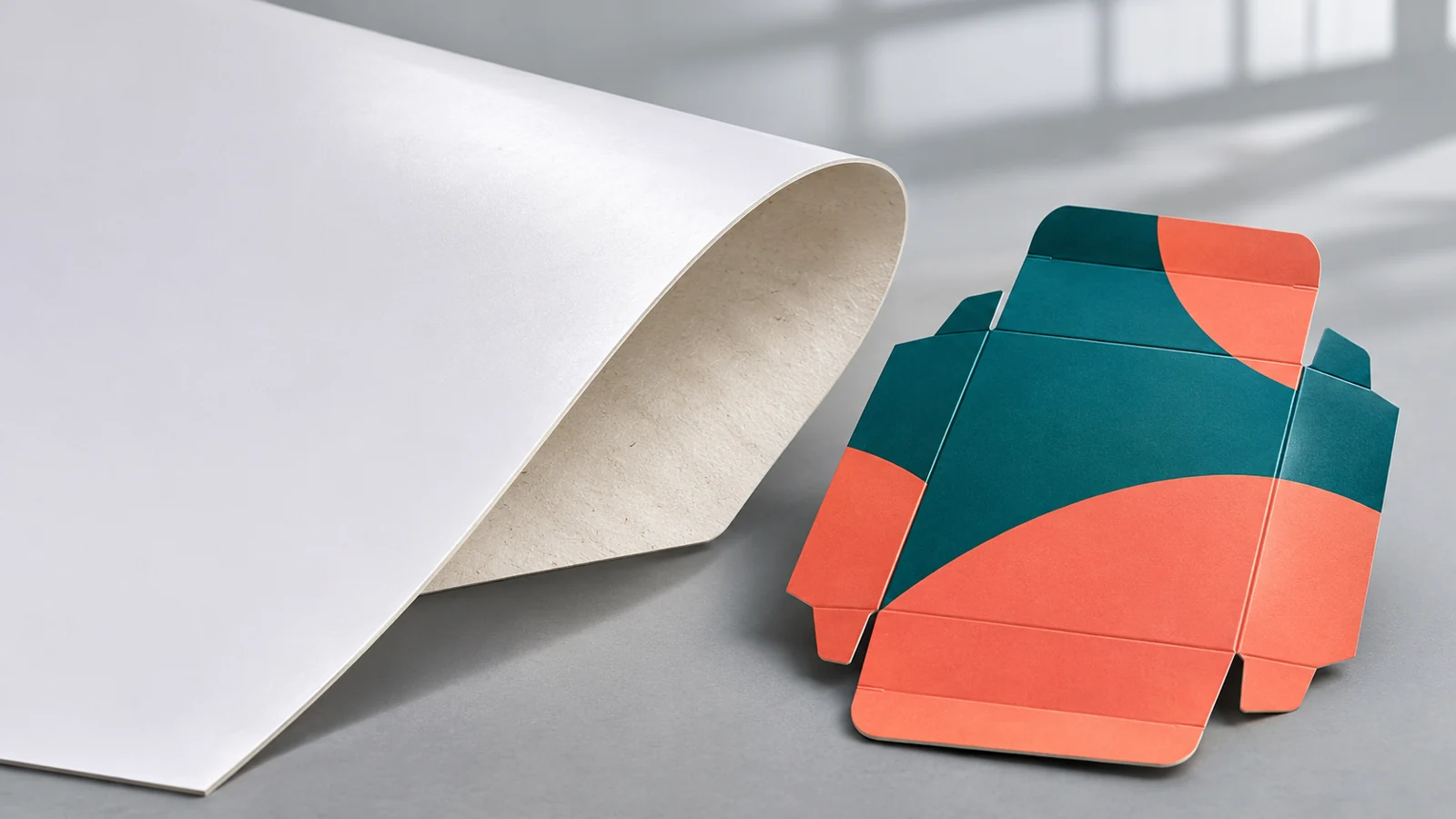
A bright white sample is an appearance check, not a press approval. Two boards can look similarly white under office lighting yet produce different solid colours, fine type, ink drying and fold results. For a packaging buyer, the useful question is what the complete printed carton must achieve.
The material behind that surface has become an industry talking point. On 2 November 2026, Packaging Insights reported on a European Commission investigation involving calcium-carbonate supply to the paper industry. The Commission opened the investigation on 23 October 2026. An investigation is not a finding of wrongdoing, a supply interruption or evidence of any change to YOUNGSUN grades. It does, however, draw attention to a mineral that can be used as a paper filler or coating pigment.
This guide is about buying the right paperboard surface, not predicting the outcome of that case. Omya's paperboard information describes the roles its calcium-carbonate products can play in optical and printing properties. Those are supplier-specific descriptions, not a guarantee for every cartonboard grade.
Separate whiteness from printing performance
Brightness or whiteness is only one visual property. Also ask about shade, opacity, surface smoothness, coating uniformity and the reverse side. The desired result depends on the intended artwork and printing process. A solid dark brand colour may expose uneven coverage that a mostly white design does not. Fine reversed type, photographs and metallic finishing each stress different aspects of the surface.
Tell the printer whether the job uses offset, flexo or digital printing and whether it will receive varnish, foil, embossing or lamination. Do not assume that the same board gives an identical result on another press or with another ink set. Ask for a representative trial when the appearance is critical.
Confirm what the white layer actually is
"White paperboard" is not a complete construction specification. The white surface might be a coated face on a folding box board, a coated reverse on a two-sided art board, or a separately laminated facing over a structural board. The base, coating and finished construction are different commercial scopes.
Ask the supplier to identify the exact grade, coated side or sides, nominal grammage, caliper, shade and acceptable variation. If a decorative sheet is laminated to grey board, clarify whether the quote refers to the facing paper, the base board or the finished laminate. Folding box board and C2S art board should be compared against the required carton structure, not merely against a white photograph.
Approve the sheet, print and carton in sequence
| Approval stage | What to inspect | What it cannot prove alone |
|---|---|---|
| Material sheet | Shade, visible uniformity, finish, reverse, caliper and grade identity | Final ink colour and runnability |
| Printed proof | Solid and fine detail, opacity, drying or set-off under the intended process | Fold, glue and finished-pack appearance |
| Converted carton | Crease, cut edge, glue, scuffing and visible finish after assembly | Long-run consistency without production controls |
Evaluate a press proof under agreed lighting and compare it with the approved colour reference. Record the ink, process, finish and material revision. If the first proof is made on a substitute board, label it as a layout or colour-development step, not a production-material approval.
For a carton, print quality cannot be separated from conversion. Review whether the printed or coated surface marks at the crease, whether the reverse and sidewalls remain acceptable, and whether glue or finishing interacts with the surface. A flat sample that looks excellent may still need a revised crease or finish. Our industry packaging applications show where structural and visual requirements meet.
Keep a change under control
A change in shade, coating, mineral formulation or supplier does not automatically mean a bad board. Nor does a familiar GSM make two constructions equivalent. If the approved grade changes, ask which properties and tests need repeating. Preserve a labelled reference sample and revision record so that purchasing, printing and quality teams compare like with like.
For food-related packaging, a clean white surface or the presence of a mineral does not establish food-contact suitability. Request documentation for the exact finished construction and intended conditions of use from the responsible supplier. Do not transfer a document for one grade to another.
Send a brief that can be quoted and trialled
Send the carton dieline, target grade or performance range, dimensions, printing method, artwork area, finishing steps, end use, destination and acceptance criteria. Ask which sheet and proof will be used for approval, and which documents are available for that grade. If the priority is colour consistency, make the approved reference and acceptable variation explicit.
If you are still comparing grades, use our materials library and paper quotation comparison guide. Contact YOUNGSUN with the application and print brief to discuss suitable samples. This article does not claim that YOUNGSUN sources calcium carbonate from Omya or that the European investigation changes our supply.
Frequently asked questions
Does a higher brightness number guarantee better printing?
No. Shade, opacity, surface uniformity, ink, press and finishing also matter. Approve a representative print for the intended job.
Is coated board always the right choice for a premium box?
No. It depends on the artwork, feel, construction and converting route. Compare representative grades against the same finished-pack brief.
Can one white paperboard sample approve every GSM?
No. Confirm the exact grade and grammage to be ordered. Changes can affect caliper, folding and print behaviour; agree which trials must be repeated.
Does the EU investigation prove a supply or price problem?
No. The Commission opened an investigation into possible conduct. It has not, by that action alone, established a supply interruption, a price outcome or wrongdoing.