
Printing Technology · 2026-10-15
AI Can Route the Print Job—But Can It Choose the Paper? 8 Data Points Buyers Still Control
AI-assisted print workflows are moving from demonstrations into real production planning. The hidden risk is feeding the workflow a generic material name instead of the paper data that determines color, ink behavior and converting performance.
Artificial intelligence is moving deeper into print production. On 14 October 2026, HEIDELBERG reported that more than 300 participants from almost 30 countries attended SHIFT 2026, where the company demonstrated AI-supported planning, automated job grouping and hybrid routing between digital and offset production. The direction is clear: software can increasingly decide how a print job should move through a plant. Read the official SHIFT 2026 report.
But there is a procurement question behind every automated workflow: what happens when the system receives incomplete paper data?
“White board,” “kraft,” “art paper” or “uncoated stock” is not enough to predict color, drying, feeding, folding or lamination. Automation can make a bad input travel faster. Buyers, converters and printers still need to define the physical substrate before an algorithm can choose a reliable production route.
This guide turns that requirement into eight practical data points for RFQs, print trials and repeat orders.
What AI-Assisted Print Planning Can—and Cannot—Do
An integrated workflow can compare run length, press availability, finishing steps, deadlines and production cost. It may route a short job to digital printing and a longer run to offset, group compatible jobs or reduce manual scheduling work.
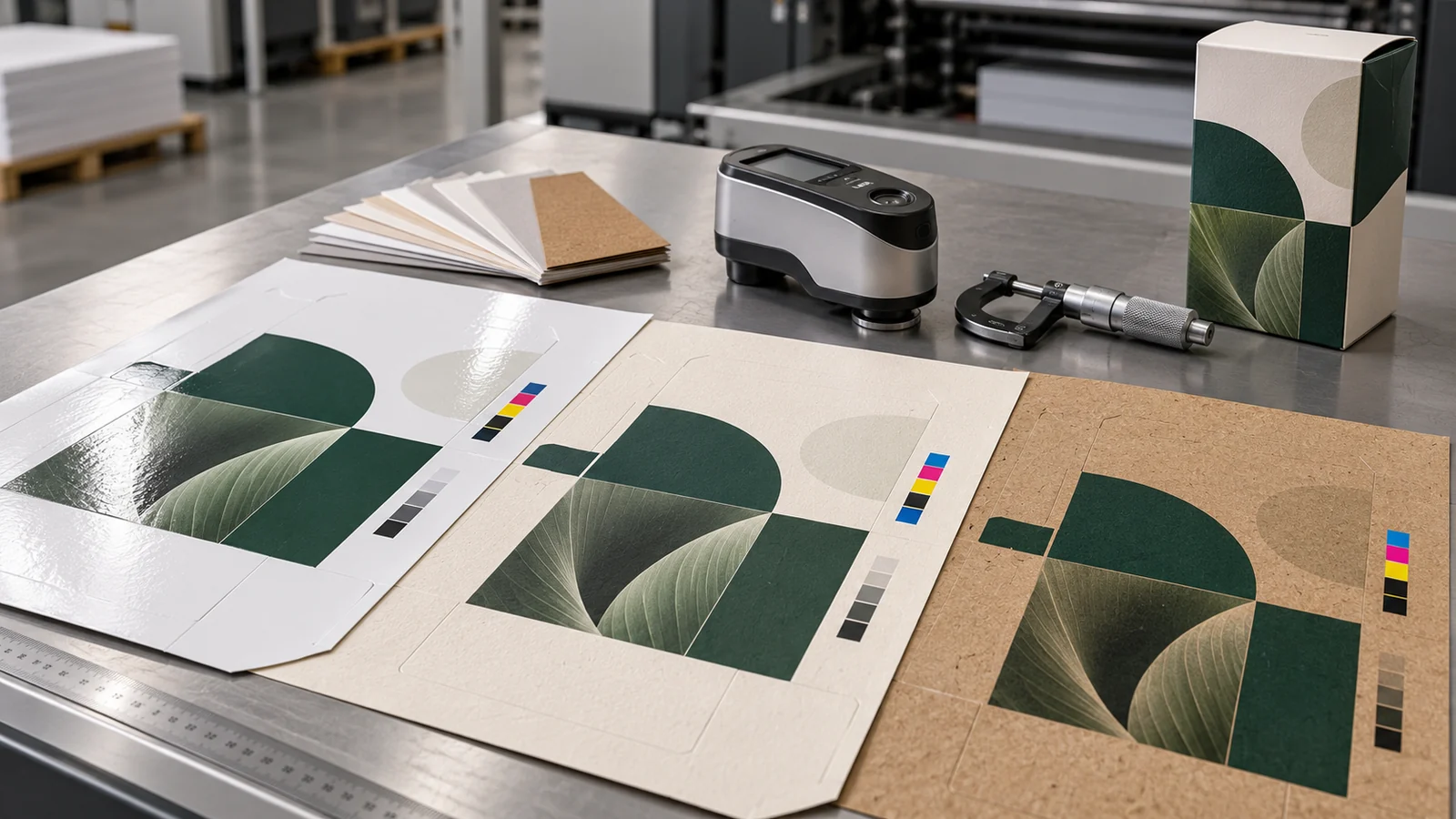
It cannot infer an exact substrate from a marketing name. The same artwork can behave differently on smooth coated board, absorbent uncoated paper and natural kraft. Fogra's characterization resources explicitly connect printing conditions with substrate categories, including coated papers, uncoated papers, LWC and newsprint. Review Fogra's characterization data.
The buyer's job is therefore not to compete with the software. It is to provide the material data that makes automation trustworthy.
1. Name the Paper Family and Intended Printing Process
Start with the commercial grade, but add the intended process: sheet-fed offset, web offset, flexography, gravure, toner or production inkjet. “Coated paper” is incomplete if the printer needs to know whether the job uses a sheet-fed offset condition or a digital engine with its own qualified media list.
For packaging, state whether the substrate is folding box board, C2S art board, kraft, colored card or another defined construction. For publications and inserts, distinguish woodfree paper, coated art paper and LWC.
If the job may move between digital and offset, ask the printer to confirm that the selected grade is approved for both routes or to nominate separate equivalents.
2. Record Grammage, Caliper and Stiffness Separately
GSM measures mass per area; it does not guarantee thickness or rigidity. Two papers with the same grammage can have different caliper, bulk and bending behavior because of fibre furnish, coating and calendaring.
Give the workflow at least:
- target grammage and tolerance;
- target caliper or thickness and tolerance;
- stiffness requirement when the pack must stand, feed or protect a product;
- density or bulk when it matters to book thickness or mailing weight.
This information affects feeder settings, press clearance, crease design, imposition and the number of sheets or finished pieces per shipment.
3. Define Paper Shade, Whiteness and Fluorescence
The paper is part of the color result. A blue-white coated sheet, a warm natural uncoated paper and brown kraft cannot reproduce the same measured or perceived color without adjustment.
Request a physical reference and, for color-critical work, available CIELAB values under the agreed measurement condition. Also ask whether optical brightening agents are relevant. Fogra notes that paper testing can include color measurements under different modes and backing conditions, which is why “white” should not be treated as one universal input. See Fogra's paper testing overview.
Brand colors should be approved on the production substrate, not only on a bright proofing paper or monitor.
4. Describe the Surface, Not Just the Finish Name
Gloss, matt, silk, smooth and rough are useful descriptions, but production planning needs measurable or testable behavior. Surface roughness, gloss, porosity, absorption and surface energy influence ink holdout, drying, rub resistance, coating adhesion and lamination.
Ask for the relevant technical data available for the grade and confirm it with a print trial. This is especially important for:
- solid dark colors on uncoated sheets;
- fine text and barcodes on textured papers;
- heavy ink coverage on kraft;
- lamination or coating after printing;
- digital presses that require a qualified surface range.
5. Identify Every Coating, Lamination and Treated Side
“Coated” can describe mineral coating, PE extrusion, silicone release treatment, primer, varnish or a laminated film. These structures do not have the same printability or end use.
Record:
- coating or laminate type;
- one-side or two-side application;
- printable side;
- treatment level or supplier recommendation where available;
- required barrier or release function;
- ink, adhesive and finishing compatibility to be tested.
Do not assume that a barrier paper is printable on both sides. For PE coated paper or silicone coated paper, define the converting route and intended contact conditions before selecting inks or adhesives.
6. Lock Format, Grain Direction and Dimensional Tolerance
Automated imposition can calculate an efficient layout only when the physical sheet or reel data is accurate. Include finished and supplied dimensions, reel width and core when relevant, grain direction, squareness and dimensional tolerance.
Grain direction affects feeding, folding, creasing and the way a finished carton or book cover resists bending. A cost-saving layout that rotates a structural panel against the required grain can create cracking or weak folds later.
Use our custom paper size and slitting guide to compare usable yield rather than nominal sheet price alone.
7. Add the Complete Finishing Route Before Press Selection
The press is only one stage. Tell the workflow whether the job will be varnished, laminated, foil stamped, embossed, scored, die-cut, folded, glued or laser processed.
A substrate that prints well may still fail during finishing. Common examples include coating that reduces glue adhesion, thick ink films that crack on a fold, weak surface fibres that lift during foil stamping, or a laminate that changes the measured color.
The Ghent Workgroup explains that a PDF/X output intent represents the intended printing condition, including the print technology and media. Read the GWG output-intent guidance. The production ticket should extend that discipline through finishing rather than stopping at the press.
8. Approve a Physical Sample and Control Substitutions
Automation depends on stable inputs. Keep one approved blank sample, one approved printed sheet and the specification revision under the same job code. If the mill, coating, shade, grammage or production route changes, require a documented review before substitution.
For a new paper grade, run a representative trial that includes the hardest elements of the job: heavy solids, fine reversals, brand colors, barcodes, folds, glue areas and finishing. A small visual sample alone cannot predict high-speed production.
The Minimum Substrate Data Handoff
| Field | What the buyer should provide or confirm | Why it matters |
|---|---|---|
| Grade | Exact commercial grade and revision | Prevents generic substitutions |
| Print route | Offset, flexo, gravure, toner or inkjet | Determines process condition and ink system |
| Structure | Fibre base, coating, laminate and treated side | Controls printability and finishing |
| Physical values | GSM, caliper, stiffness and tolerances | Supports feeding, creasing and logistics |
| Optical values | Shade reference and color data when available | Protects brand-color expectations |
| Format | Sheet/reel dimensions, grain and core | Enables correct imposition and converting |
| Finishing | Coating, foil, embossing, die-cutting, folding and gluing | Reveals compatibility risks early |
| Approval | Blank sample, printed proof and change-control owner | Keeps repeat orders consistent |
A Practical Buyer Workflow
- Choose the end use first. Define the package, publication or printed item and its performance requirements.
- Shortlist the paper family. Compare structure and surface before discussing only price.
- Send one complete specification. Use the same fields for every supplier and printer.
- Test on the proposed route. Include printing and the critical finishing operation.
- Freeze the approved combination. Link artwork, output intent, substrate revision and production sample in the job record.
This approach lets AI and automation do what they are good at—routing, grouping and optimizing—without asking software to guess the material.
What This Means for Paper Buyers
The next competitive advantage in print is not “AI versus paper expertise.” It is structured paper expertise that software can use. A precise substrate specification reduces ambiguity between buyer, supplier, printer and converter, and it creates better data for automated planning.
YOUNGSUN PAPER can provide representative samples and available specifications for grades such as coated board, woodfree paper, kraft paper, color card and specialty paper. Standard samples are free; international courier charges are paid by the customer. Send your printing process, target GSM, size and finishing route for a material review, or explore our packaging and printing application guidance.
Frequently Asked Questions
Can AI choose the correct paper automatically?
AI can compare options only when the available media data and production rules are accurate. A generic product name is not enough to predict color, drying, feeding or finishing performance. A qualified paper list and physical trial remain important.
Is GSM enough for automated print planning?
No. Grammage should be accompanied by caliper, stiffness or bulk where relevant, surface information, format, grain direction and the finishing route.
Why can the same artwork look different on coated, uncoated and kraft paper?
Paper shade, roughness, absorption and gloss change ink holdout and perceived color. The file and proof should use an output condition appropriate to the actual substrate, followed by approval on production material.
What should be rechecked after a paper substitution?
Confirm shade, caliper, stiffness, surface behavior, ink drying, color, folding, gluing and other critical finishing results. Update the specification and retain the new approved sample before full production.