
Packaging & Procurement · 2026-10-26
Can a Paper Label Complicate Plastic Recycling?
A paper label can look like an easy sustainability improvement. But the package is recycled as a system, and the label's adhesive and behaviour in washing can change the result.
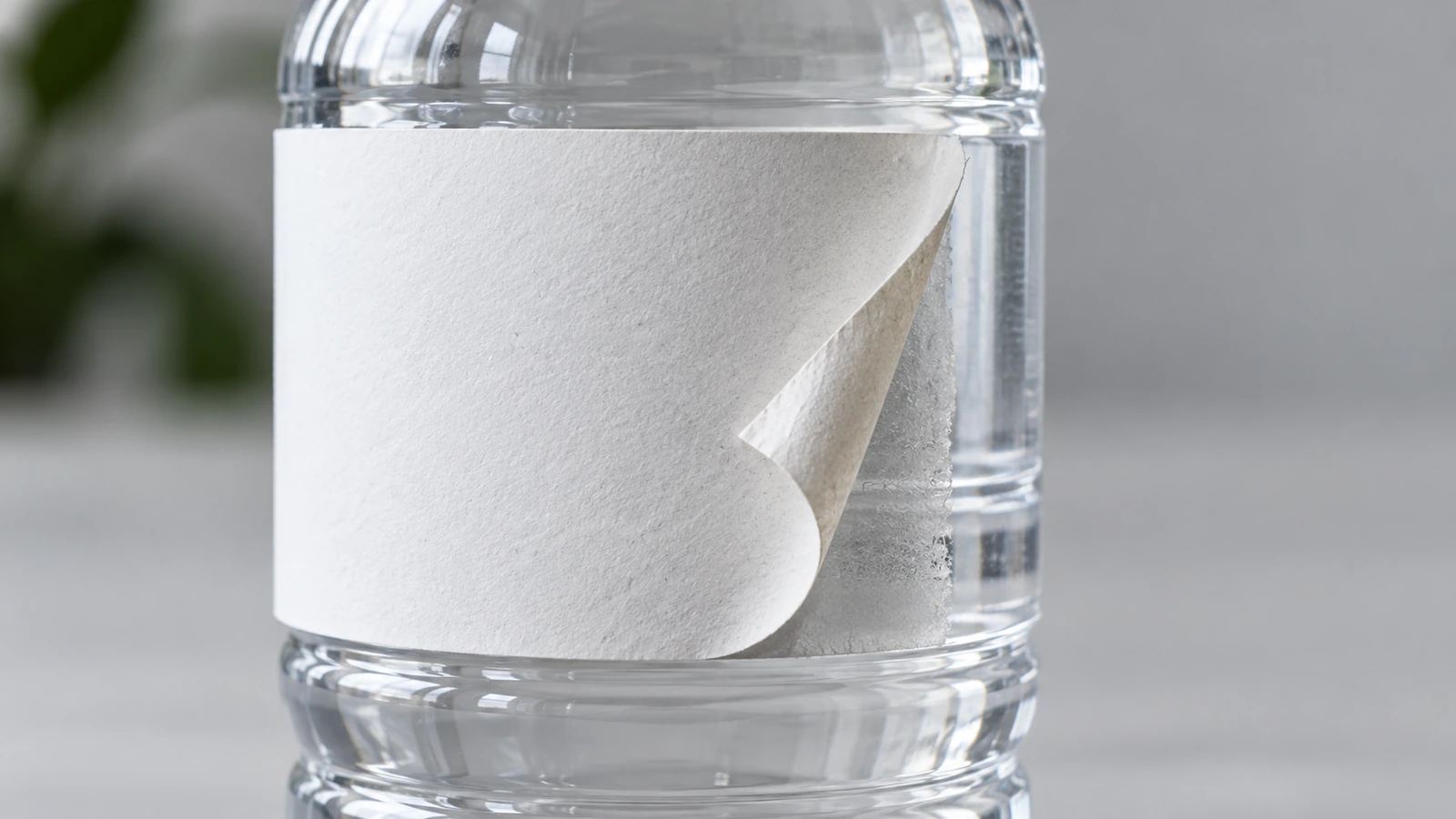
Not necessarily. A paper label on a plastic bottle may be suitable for a particular pack, but paper facestock alone cannot establish that the *whole package* is recyclable. The container, label, adhesive, ink, coverage and recycling process need to be assessed together.
This question is timely because an October 2026 Packaging Europe discussion put labels at the centre of design-for-recycling decisions. RecyClass also describes label and adhesive testing for plastic packaging. These developments do not mean every paper label is unsuitable. They mean a buyer should request evidence for the *specific label-on-container construction*, rather than assume the label material settles the issue.
This article is a procurement checklist, not a certification or a legal conclusion. Recycling systems and accepted claims vary by market.
Start with the container's recycling stream
Write down whether the pack is a PET bottle, PET tray, HDPE container, PP container or another format. Do not transfer an approval from one stream to another. A label that separates acceptably from a PET bottle may behave differently on an HDPE tub or PET tray.
RecyClass publishes design-for-recycling guidelines by packaging stream. Its guidance distinguishes fully compatible, limited and incompatible features. Ask the converter which guideline and version they used, then compare that answer with the destination market's actual collection and sorting route. A European technical assessment is not automatic proof of recycling access in Mexico, Colombia or another export market.
The label is more than its visible paper face
The delivered construction can include a paper facestock, primer or topcoat, ink, varnish and adhesive. Some labels also use a release liner during application; the liner has its own disposal route and is not the same as the label left on the container.
When specifying label paper, tell the supplier how it will be printed, coated, die-cut and attached. Then ask the label converter to identify the complete finished label. If an adhesive or coating is chosen later, repeat the compatibility review. A paper sample cannot validate an adhesive that has not been selected.
| Purchasing question | Evidence to request |
|---|---|
| Which container and stream? | Polymer, format, colour and target recycling guideline |
| What remains on the pack? | Finished label construction, coverage and application drawing |
| How does the label separate? | Test result for the label-and-adhesive combination under the relevant wash conditions |
| What happens to ink and fibres? | Observations on residue, fibre loss and contamination where the protocol assesses them |
| Where will the pack be sold? | Local collection, sorting and claim review for each target market |
Why wash-off results matter
For HDPE and PP containers, RecyClass explains that its wash-off procedures for labels assess separation during recycling. Its guidance also addresses fibre loss from paper labels in that process. The stated wash conditions belong to that specified recycling stream and protocol; they are not a universal temperature requirement for all labels or all countries.
For PET bottles, RecyClass has a separate evaluation protocol for adhesives and labels. It evaluates whether the label detaches and whether adhesive residue remains on washed PET. PET thermoforms use another assessment: a recent RecyClass technology approval covers specific PP-faced label technologies on PET trays, not all labels on all trays.
The lesson for procurement is simple: request the protocol, tested construction, result and scope. “Wash-off adhesive” in a catalogue is not a complete test report. Equally, a failure in one construction does not disqualify every paper facestock.
Keep paper-packaging and plastic-packaging claims separate
If the label is applied to a paperboard carton, evaluate it with the paper-based package, not with a plastic-container guideline. The 4evergreen Circularity by Design Guideline provides a different framework for paper-based packaging. If the label goes on a plastic bottle, use the relevant plastic recycling stream instead.
FSC sourcing documentation answers a separate question about certified fibre. It does not establish wash-off behaviour, collection availability or finished-pack recyclability. Likewise, a label that is recyclable by itself does not automatically make the container-plus-label combination recyclable.
Put the decision into the RFQ
For an overseas label-paper request, send the paper grade supplier and converter the same brief:
- Container polymer, shape, colour and destination countries.
- Label dimensions and approximate percentage of surface covered.
- Printing method, inks, coating and moisture or abrasion exposure.
- Adhesive chemistry and application method, with the converter named as owner.
- Relevant recycling guideline and the evidence expected for the finished combination.
- Any required certification claim, stated separately from recyclability.
Approve print performance and recycling evidence as separate gates. A label can look excellent and still need a different adhesive; a label that washes off well may still need print, condensation or scuff trials for the intended use. Keep both the approved material reference and the test report linked to the same construction revision.
YOUNGSUN PAPER can discuss paper facestock options and samples; this article does not claim that a YOUNGSUN label-paper grade has a RecyClass approval or is validated on a particular bottle. The label converter and package owner should qualify the final system. Send your application details, or compare the paper specification checklist before requesting quotes.
Frequently asked questions
Is a paper label automatically recyclable on a PET bottle?
No. The complete bottle, label and adhesive need evaluation for the relevant PET recycling process and destination market. Ask for the tested construction and applicable protocol.
Can the same wash-off result be used for a PET tray and an HDPE container?
No. They are different recycling streams with different guidelines and test conditions. Request evidence for the actual pack format.
Does FSC certification prove the finished pack is recyclable?
No. FSC addresses fibre sourcing and chain-of-custody claims. Recyclability depends on the finished construction and collection and processing conditions.
What should a paper supplier confirm before quoting?
The intended face material, print and converting conditions, label dimensions and any grade-specific documentation it can provide. Adhesive selection and whole-pack recycling claims must also be resolved with the converter and package owner.