
Products · 2026-08-05
Folding Box Board (FBB) Complete Buyer Guide: Grades, Applications, and Sourcing Tips
Folding box board is the workhorse of retail packaging — cosmetics boxes, pharma cartons, food packaging. This guide covers FBB grades (GC1, GC2), key specifications, how to evaluate quality, and what to ask your supplier.
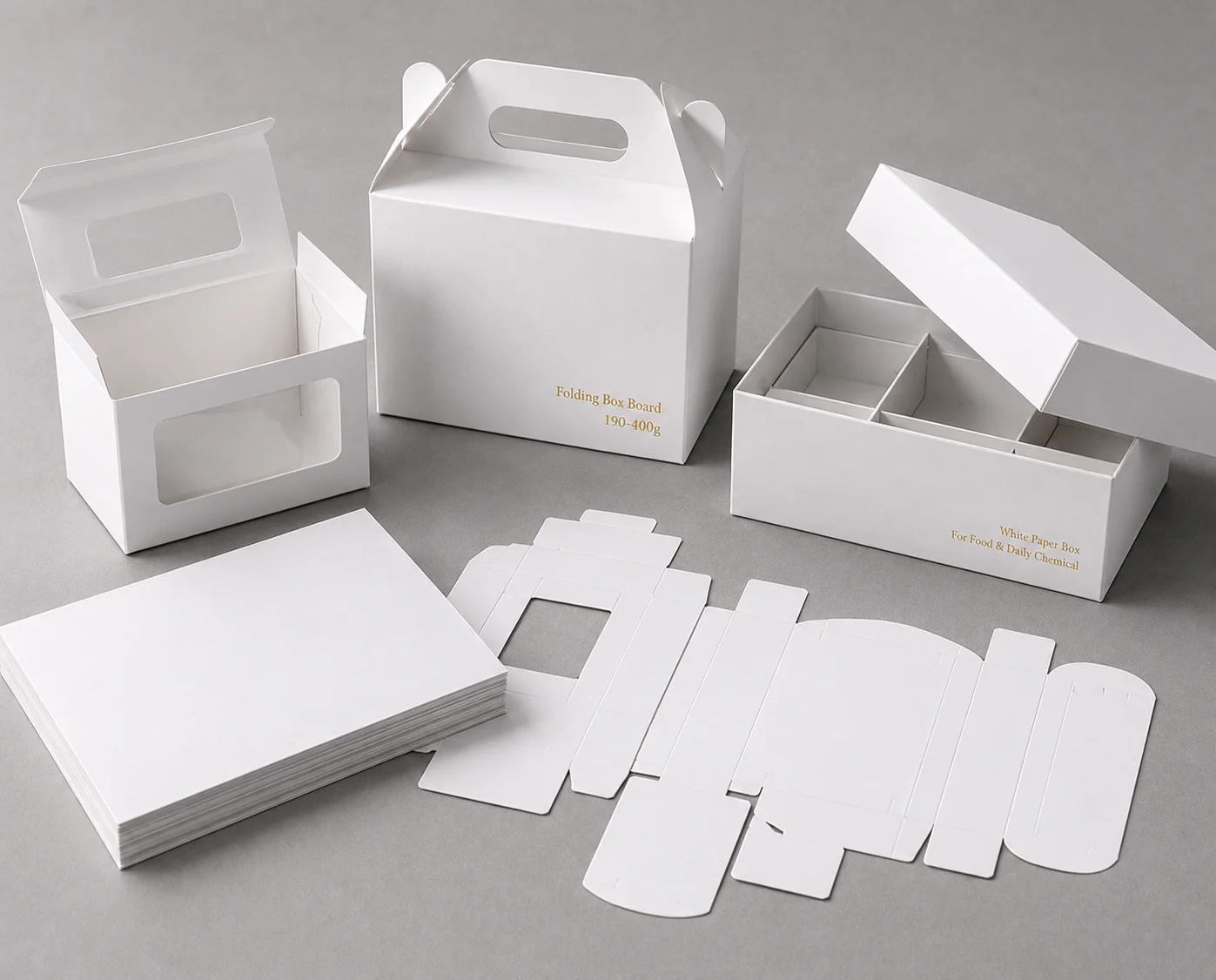
Folding box board — commonly abbreviated as FBB — is one of the most widely specified paperboard grades in the world. If you have ever opened a cosmetics box, a pharmaceutical carton, a frozen food package, or a premium retail carton, there is a high probability you were holding FBB.
For packaging buyers, FBB sits in the sweet spot between economy and performance: it prints beautifully, folds cleanly, and costs less than solid bleached sulphate (SBS) board. But FBB is not one single product. It comes in different grades, coating configurations, and stiffness levels — and choosing the wrong one leads to cracking on the fold, poor print reproduction, or cartons that fail on high-speed filling lines.
This guide explains everything a buyer needs to know about folding box board: what it is, how grades differ, typical specifications, and how to source it correctly.
What Is Folding Box Board?
Folding box board is a multi-layer paperboard with a mechanical pulp middle layer sandwiched between chemical pulp outer layers. The top layer is typically coated with one to three layers of coating (clay and/or calcium carbonate) to create a smooth, white printing surface. The back layer may be white, cream, or light grey depending on the grade.
This three-layer structure is what gives FBB its characteristic combination of properties:
- Top layer (chemical pulp + coating): Print surface — smooth, white, receptive to ink and varnish
- Middle layer (mechanical pulp): Bulk and stiffness — thicker fibers provide rigidity without adding proportional weight
- Back layer (chemical pulp or light-colored recycled fiber): Reverse side — may be uncoated or lightly coated depending on grade
FBB Grades: GC1, GC2, and Beyond
The most common FBB grade designations come from the German classification system, which is widely used in international trade:
GC1 (Grey Back / White Back)
GC1 is the standard premium FBB grade. It features:
- Multi-coated white top surface
- White or cream back (sometimes called "white back FBB")
- Virgin fiber construction throughout
Best for: Cosmetics, pharmaceuticals, premium food packaging, and any application where the inside of the carton should look clean and white.
GC2 (Grey/Cream Back)
GC2 is the economy FBB grade. It features:
- Multi-coated white top surface
- Grey or light-grey back layer (recycled fiber content)
- Slightly lower cost than GC1
Best for: General retail cartons, household products, dry food packaging, and applications where the inside surface color is not critical.
C1S Ivory Board
Often discussed alongside FBB, C1S ivory board is a high-bulk board with one coated side (typically the top) and an uncoated reverse. It combines FBB-like stiffness with a premium ivory appearance.
Best for: Premium hang tags, greeting cards, covers, and packaging where the board's natural ivory color contributes to the design.
Key FBB Specifications
| Property | GC1 (White Back) | GC2 (Grey/Cream Back) |
|---|---|---|
| Top surface | Multi-coated, bright white | Multi-coated, bright white |
| Back surface | White or cream, lightly coated or uncoated | Grey or light-grey, uncoated |
| Fiber | Virgin (chemical + mechanical pulp) | Mixed (virgin top, recycled content in back) |
| Typical GSM range | 200–400 GSM | 200–400 GSM |
| Common thickness | 0.30–0.60 mm | 0.30–0.60 mm |
| Brightness (top) | 88–92% ISO | 88–92% ISO |
| Smoothness (top) | 1.0–1.5 μm (PPS) | 1.0–1.5 μm (PPS) |
| Stiffness | High (mechanical pulp middle) | High (mechanical pulp middle) |
| FSC availability | FSC Mix certified | FSC Mix / Recycled certified |
FBB vs Other Carton Boards
FBB vs SBS (Solid Bleached Sulphate)
SBS is the premium carton board made from 100% bleached chemical pulp. It offers higher brightness, better whiteness, and superior odor/taste neutrality (important for food packaging). FBB offers higher stiffness at equivalent GSM — a 230 GSM FBB can be stiffer than a 250 GSM SBS. FBB is typically lower cost than SBS.
FBB vs Duplex Board
Duplex board has a coated white top and a grey back, similar to GC2 FBB. The difference is that duplex board typically uses more recycled fiber and has lower stiffness. FBB is the premium alternative for applications where folding performance, stiffness, and consistent print quality matter.
FBB vs C2S Art Board
C2S art board is coated on both sides and is designed for premium printing on both faces. FBB is designed for carton converting — folding, creasing, gluing. C2S is chosen for print quality; FBB is chosen for converting performance plus print quality.
How to Evaluate FBB Quality
When sampling FBB, evaluate these properties:
- Print gloss and ink holdout — Print a test image. Does the coating hold ink without mottling? Is the gloss uniform?
- Creasing and folding — Score and fold the board at 90° and 180°. Does it crack at the fold? Cracking on the fold line is a common FBB quality issue.
- Stiffness — Does the board feel rigid enough for the carton size? A larger carton needs a stiffer board.
- Flatness — Sheets must lie flat for sheet-fed printing. Curled or wavy sheets cause feeding problems.
- Delamination resistance — The layers must not separate during printing, creasing, or use.
- Odor and taint — For food and pharma packaging, the board must be organoleptically neutral.
Common FBB Applications
FBB is used across virtually every consumer goods category:
- Cosmetics: Skincare cartons, fragrance boxes, makeup packaging
- Pharmaceuticals: Medicine cartons, patient information leaflet packaging
- Food: Dry food cartons (cereal, pasta, biscuits), frozen food packaging
- Beverage: Multi-pack cartons, cup sleeves
- Electronics: Accessory boxes, charger packaging
- Household: Detergent cartons, home care product packaging
- Confectionery: Chocolate boxes, gift confectionery packaging
Sourcing FBB from China: What to Ask Your Supplier
When requesting an FBB quotation from a Chinese supplier, include:
- Grade: GC1, GC2, or specify if you need a particular mill brand
- GSM: 210, 230, 250, 270, 300, 330, 350, or 400 GSM
- Format: Sheets (specify size in mm) or reels (specify width and max diameter)
- Printing method: Offset, flexo, or digital — this affects which coating formulation is recommended
- Application: Food, pharma, cosmetics, general — this affects food-contact and odor requirements
- Certification: FSC, food-contact compliance documents for target market
- Volume: Metric tons or number of sheets
- Destination port: For freight quotation
A good supplier will ask you about your application and converting process before quoting a grade — not simply respond with a price.
FAQ
What is the difference between FBB GC1 and GC2?
GC1 has a white or cream back. GC2 has a grey or light-grey back (contains recycled fiber). GC1 is preferred for premium packaging and applications where the inside of the carton is visible. GC2 is more economical for general carton applications.
What GSM is best for cosmetics packaging?
250–330 GSM is the typical range for cosmetics cartons. 300 GSM is a common choice for luxury skincare and fragrance cartons.
Is FBB food-safe?
FBB can be manufactured to food-contact standards, but food-safety compliance is not automatic — it must be specified and documented. Confirm the required compliance standard (FDA, EU 1935/2004, GB 9685) with your supplier.
Can FBB be hot foil stamped?
Yes. FBB's smooth coated surface is excellent for hot foil stamping, embossing, and spot UV.
What is the minimum order quantity for FBB from China?
Typical MOQ is 1–3 metric tons, though pricing improves at container-load volumes (20–25 tons per 40HQ container).