
Packaging · 2026-08-05
Grey Board vs Duplex Board: The Complete Comparison for Packaging Buyers
Grey board and duplex board look similar on a specification sheet but serve completely different purposes in packaging production. This guide breaks down the differences — and helps you choose the right one for your project.
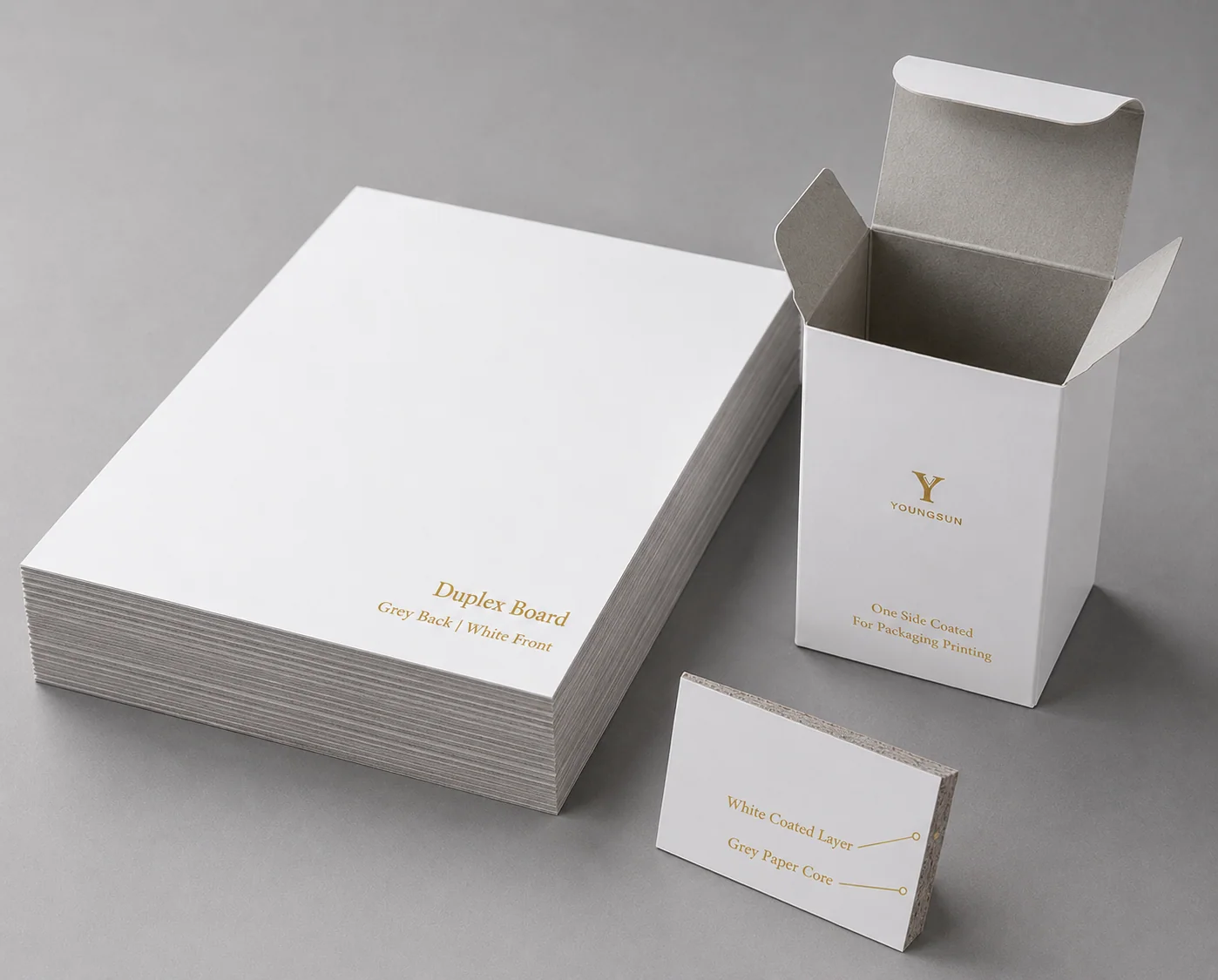
Two of the most commonly confused paperboard grades in packaging procurement are grey board (also called grey chipboard) and duplex board (also called grey back board or white back duplex). They both have a grey component. They both come in sheets. And on a quick glance at a specification table, they can look interchangeable.
They are not.
Choosing the wrong one means boxes that collapse during shipping, printing that looks washed out on a grey surface, or paying for print quality you don't need because the board will be wrapped anyway.
This guide compares grey board and duplex board across the dimensions that matter most for packaging buyers: composition, surface, stiffness, printability, applications, cost, and converting behavior.
What Is Grey Board?
Grey board is a dense, uncoated paperboard made primarily from recycled fiber. It has a natural grey color on both sides, a smooth but uncoated surface, and high stiffness relative to its weight. It is typically manufactured in thicknesses from 0.5 mm to 3.0 mm, with higher densities available for structural applications.
Grey board's primary job is structure. It provides the rigid backbone inside luxury gift boxes, hardcover books, puzzle boards, file folders, and display mounts. It is rarely the visible surface in a finished product — instead, it is wrapped, laminated, or mounted with decorative paper, fabric, leatherette, or printed sheets.
Key characteristics:
- Through-grey color (both sides identical)
- High stiffness and flatness
- Smooth uncoated surface suitable for gluing and mounting
- Made from 100% post-consumer recycled fiber (FSC Recycled available)
- Not designed for direct high-quality offset printing
What Is Duplex Board?
Duplex board is a two-layer paperboard: a coated white top layer for printing, bonded to a grey back layer that provides thickness and stiffness at lower cost. The white top is typically clay-coated for smoothness and print receptivity, while the grey back is uncoated.
Duplex board's primary job is printable packaging at an economical price point. It is widely used for retail cartons, display packaging, backing boards, shoe boxes, and general consumer goods packaging where one side needs to look good and the other side is hidden inside the carton.
Key characteristics:
- Coated white printing surface on top
- Grey uncoated back
- Moderate stiffness (less than grey board at equivalent thickness)
- Good offset and flexo print quality on the coated side
- More economical than FBB (folding box board) for many applications
Side-by-Side Comparison
| Property | Grey Board | Duplex Board |
|---|---|---|
| Fiber source | 100% recycled (post-consumer) | Mixed (recycled grey back, cleaner fiber on white top) |
| Surface | Both sides grey, uncoated | One side white coated, one side grey uncoated |
| Printability | Not designed for direct quality printing | Good offset/flexo on white side |
| Stiffness | High (dense fiber structure) | Moderate (softer structure) |
| Thickness range | 0.5–3.0 mm | 0.3–1.0 mm typical |
| Main use | Structural base for rigid boxes, book covers | Printed retail cartons, display boxes |
| Cost position | Economical structural board | Economical printable carton board |
| FSC availability | FSC Recycled certified | FSC Recycled certified |
| Common sheet sizes | 787×1092 mm, 889×1194 mm | 787×1092 mm, 889×1194 mm |
When to Choose Grey Board
Choose grey board when your packaging project needs structure first, printability second (or not at all).
Grey board is the right choice for:
- Rigid gift boxes — The grey board forms the structural shell. It will be wrapped with printed art paper, black paper, fancy paper, fabric, or leatherette.
- Hardcover book covers — The stiff board inside the cover that gives a book its rigid feel.
- Jigsaw puzzles and game boards — Flat, stiff, dimensionally stable substrate.
- File folders and ring binders — Long-term durability and stiffness.
- Display and mounting boards — Backing that stays flat under the weight of mounted items.
- Calendar backs and notepad bases — A stiff backer that keeps the product flat.
If your finished package will have the grey board visible to the customer, you are probably using grey board as a structural layer beneath a decorative wrap — not as the final surface.
When to Choose Duplex Board
Choose duplex board when your packaging needs one printable side and modest structural performance at an economical price.
Duplex board is the right choice for:
- Retail folding cartons — Cereal boxes, toy packaging, household product cartons, where the outside is printed and the inside is grey.
- Display packaging — Counter displays, shelf trays, promotional packaging with printing on the visible side.
- Shoe boxes — Printed outside, grey inside, with sufficient stiffness for stacking.
- Backing boards for blister packs — Stiff, printable, and cost-effective.
- Economical gift boxes — Lower-cost alternatives to rigid boxes, where the box itself is printed (not wrapped).
If your package needs direct printing and the inside surface won't be seen, duplex board is often the most cost-effective choice.
The Critical Question: Will It Be Printed or Wrapped?
This is the single question that most reliably separates grey board from duplex board projects:
- Wrapped / mounted / covered → Grey board. The decorative surface comes from the wrapping material, not the board itself. The board provides structure.
- Printed directly → Duplex board (or FBB, C2S, depending on quality requirements). The board surface is the packaging surface.
There is a middle ground: some converters print directly onto grey board for utilitarian applications (simple one-color logos, internal dividers, industrial packaging). But these are exceptions. For any packaging where print quality affects the customer's perception of the product, grey board should be wrapped, not printed.
Cost Comparison
At equivalent thickness, grey board is typically more economical per sheet than duplex board because it is made from 100% recycled fiber with no coating process. However, cost-per-sheet comparisons can be misleading — the total project cost depends on the entire converting process.
A rigid box using grey board requires:
- Grey board (structural base)
- Wrapping paper (decorative surface)
- Glue/adhesive
- Labor for mounting and wrapping
A carton using duplex board requires:
- Duplex board (structure + print surface in one)
- Printing (ink, plates, press time)
- Die-cutting, folding, gluing
The total cost comparison depends on your converting setup, labor costs, order volume, and whether you do wrapping in-house or outsource it.
Can You Use Grey Board and Duplex Board Together?
Yes. Many premium packaging projects use both:
- Duplex board for the outer printed carton or slipcase
- Grey board for the inner rigid structure, tray, or platform
This combination gives you print quality on the outside (duplex) and structural integrity on the inside (grey board). It is common in cosmetic packaging, electronics packaging, and premium gift sets.
How to Specify Your Requirement to a Supplier
When requesting a quotation for either board, include:
- Board type: Grey board or duplex board
- Required thickness (mm) or GSM
- Sheet size (width × length in mm)
- For grey board: wrapping material and method (will affect gluing compatibility)
- For duplex board: printing method (offset, flexo, digital) and number of colors
- Application (rigid box, carton, book cover, etc.)
- FSC certification required?
- Quantity and target delivery schedule
FAQ
Which is stronger — grey board or duplex board?
Grey board has higher stiffness and density at equivalent thickness. It is the stronger structural board.
Can grey board be printed on?
Grey board can accept simple one-color printing, but it is not designed for high-quality process-color offset printing. For printed packaging, choose duplex board, FBB, or C2S art board.
Is duplex board the same as folding box board?
No. Duplex board has one coated white side and one grey back. Folding box board (FBB) typically has multiple coating layers on the top and a cream or white back, with higher print quality and stiffness for premium retail cartons.
Is grey board FSC certified?
Yes. YOUNGSUN grey board is available with FSC Recycled certification.
What's the difference between grey board and chipboard?
Grey board and chipboard are the same material. In some regions (especially North America), it is called chipboard; in Asia and Europe, grey board or grey chipboard is more common.