
Sustainability · 2026-10-09
85% Paper Sounds Sustainable—But Is It Recyclable? 7 Questions Buyers Should Ask
A new frozen-dessert wrapper made with up to 85% paper has put material percentages back in the spotlight. Here is how packaging buyers can separate a promising composition figure from a verified recyclability claim.
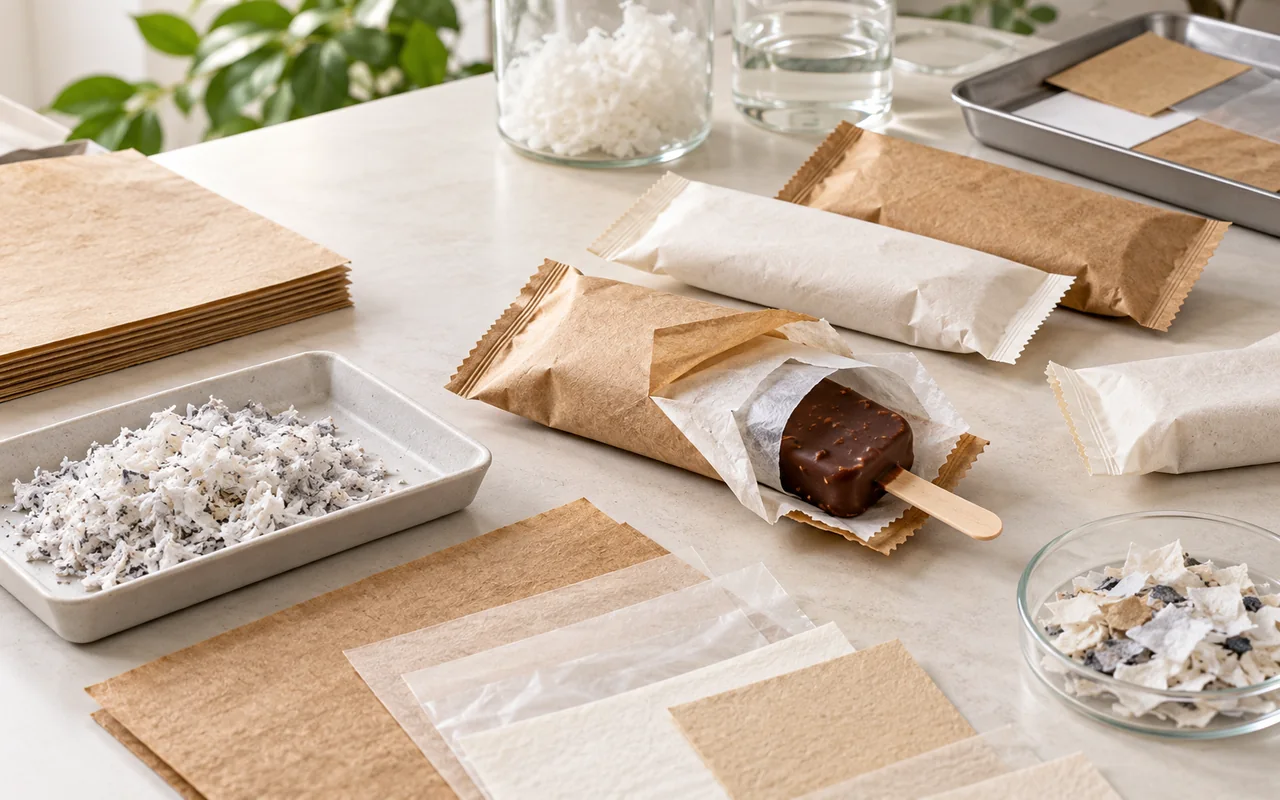
On 6 October 2026, Tetra Pak announced an ice cream wrapper made with up to 85% paper. The company states that the remaining materials include polymer, ink and lacquer, and plans a phased European rollout from the fourth quarter of 2026. The announcement is a useful sign of where flexible food packaging is moving: more fibre, thinner functional layers and closer attention to cold-chain performance. Read the official announcement from Tetra Pak.
For a packaging buyer, however, one important question remains: does a high paper percentage automatically make the finished pack recyclable?
The short answer is no. Paper content describes composition. Recyclability depends on the complete packaging structure, the way it is collected and sorted, whether its fibres can be recovered in a suitable mill, and the rules of the destination market. This article does not assess the recyclability of the newly announced product. Instead, it uses the news as a practical starting point for evaluating any paper-based barrier package.
Why Paper Percentage and Recyclability Are Different Claims
A percentage such as 85% tells a buyer how much of the package is paper by weight under the supplier's stated method. It does not by itself explain whether the package will enter a paper collection stream, whether its barrier layers separate during pulping, how much usable fibre is recovered, or how the residual material is handled.
This distinction matters because food packaging needs performance. Moisture, grease, oxygen, aroma, heat sealing and cold-chain handling may require coatings, laminates, inks or adhesives. The Confederation of European Paper Industries (Cepi) notes that these functional treatments can make recycling more challenging and recommends considering the intended use and end-of-life together.
The buyer's job is therefore not to reject every non-paper layer. It is to confirm that each layer is necessary, controlled and compatible with the intended recovery route.
1. What Makes Up the Remaining Percentage?
Ask for a layer-by-layer description of the finished package, not just the base paper. The answer should identify the paper substrate, barrier coating or film, sealing layer, adhesive, ink and lacquer where applicable.
Request the weight or proportion of each constituent and ask what function it performs. A useful specification connects every non-paper component to a requirement such as grease resistance, moisture protection, heat sealing or print protection.
If the supplier cannot explain the remaining percentage, the headline paper figure is not enough for a purchasing decision.
2. Will the Pack Be Collected as Paper in the Target Market?
Technical repulpability is only one part of the route. The used pack must first be accepted by a local collection system and recognised at sorting facilities.
Ask which disposal instruction applies in each sales market. A structure accepted in one country may receive different guidance in another because collection and sorting systems differ. Cepi's guidance specifically recommends checking national extended producer responsibility schemes and local assessment protocols.
For exports, record the intended country before approving a recyclability statement. Do not use one global disposal claim unless the evidence supports every target market.
3. Can a Paper Mill Recover the Fibres?
The key technical question is whether the paper fraction breaks down into usable fibres during pulping and whether non-paper components can be removed through screening and cleaning.
Ask whether the finished structure has been tested using a recognised method. Cepi's Recyclability Laboratory Test Method Version 3 simulates important stages of a conventional paper recycling mill, including pulping, screening and sheet formation.
A general statement that “paper is recyclable” is not equivalent to a result for the complete printed, coated and sealed package.
4. How Do Coatings, Inks and Adhesives Behave During Recycling?
Small material quantities can still affect a recycling process. Ask whether barrier coatings disperse, remain as screenable particles or create sticky contaminants. Ask how inks, varnishes and adhesives behave in the selected test method.
The most useful answer is supported by a test report that identifies the exact construction. A report for uncoated base paper does not prove the recyclability of a converted wrapper.
When comparing materials such as greaseproof paper, PE coated paper and silicone coated paper, compare both the required barrier performance and the end-of-life evidence available for the finished application.
5. What Performance Is Actually Necessary?
Reducing a barrier too far can create product loss, leakage or food waste. Start with the real application: product fat content, moisture, storage temperature, shelf life, filling process, sealing method and transport conditions.
Then ask for the lightest structure that meets those verified requirements. For a dry bakery item, an uncoated or grease-resistant fibre solution may be suitable. A frozen product or liquid-contact application can require a different structure. Review food and beverage paper solutions and test the proposed material in the real converting and packing process.
The correct comparison is not “paper versus plastic” in the abstract. It is one complete packaging system versus another, including product protection and end-of-life.
6. Which Claim Can Be Used in the Destination Market?
Ask for the exact wording the supplier believes the evidence supports: paper content, fibre source, technically recyclable, recyclable in a particular collection stream, or certified under a named protocol. These are different claims.
The EU Packaging and Packaging Waste Regulation began applying in phases on 12 August 2026. The European Commission's PPWR update explains that requirements for all packaging to be recyclable apply from 2030, alongside further technical rules and implementation work.
Buyers selling into the EU should follow the regulation and subsequent delegated rules, but the same discipline is useful everywhere: keep the claim, test method, tested sample and target market in one approval file.
7. Was the Finished Pack Tested, or Only the Base Material?
This is the most important verification question. Printing, coating, lamination, heat sealing and adhesive application can change recycling behaviour. Ask for evidence on the commercial structure or a representative converted sample.
Match these five details before accepting a test report:
| Evidence item | What should match your order |
|---|---|
| Material structure | Paper grade, coating, film and adhesive |
| Conversion | Printing, lacquer, lamination and sealing process |
| Basis weight | GSM and coating or film weight |
| Test method | Named method, laboratory and report date |
| Market scope | Country or collection stream covered by the claim |
If one item is different, ask whether additional testing is needed.
A Practical RFQ Checklist for Paper-Based Barrier Packaging
Before requesting a quotation, prepare the application and destination first. Then ask suppliers to complete the same information table so that proposals can be compared fairly.
- Packed product and direct-food-contact status
- Required grease, moisture, oxygen or aroma barrier
- Filling, wrapping and sealing method
- Storage temperature, shelf life and transport conditions
- Paper GSM, finished size and expected order volume
- Full layer structure and non-paper percentage
- Printing, ink, varnish and adhesive system
- Available food-contact and recyclability documentation
- Destination country and intended disposal instruction
- Converted sample or production trial requirement
For cups and takeaway formats, compare the barrier structure on the cup paper page. For fibre-led outer packaging, review kraft paper. Always approve the finished construction rather than selecting only by the paper name.
The Buying Decision in One Sentence
A high paper percentage is a useful design signal, but recyclability is a system result that needs market-specific evidence on the finished pack.
This is why a strong RFQ asks two separate questions: “What is the package made from?” and “What evidence shows what happens after use?” When both answers are clear, buyers can compare performance, compliance and end-of-life without relying on a single headline number.
To compare paper-based barrier options for a specific product, send YOUNGSUN PAPER your application, target market and converting requirements. Our team can help organise suitable material samples and the documents available for evaluation; final compliance and recyclability claims should be confirmed for the selected construction and destination.
Frequently Asked Questions
Does 85% Paper Mean a Package Is Recyclable?
No. It describes material composition, not the complete collection, sorting and fibre-recovery route. Recyclability should be supported by evidence for the finished package and the target market.
Is a Coated Paper Package Recyclable?
It may be, depending on the coating, its quantity, the complete converted structure and the recycling process available. Ask for a recognised test result and local collection guidance.
Should Buyers Avoid All Plastic Barriers?
Not automatically. A barrier may be necessary to protect food or enable sealing. Buyers should minimise unnecessary material while verifying product performance and compatibility with the intended end-of-life route.
What Documents Should a Supplier Provide?
Ask for the material structure, technical data sheet, relevant food-contact documents, the named recyclability test method and report, the tested sample description, and the market scope of any claim.
Can a Base-Paper Test Cover the Finished Wrapper?
Not necessarily. Printing, coatings, adhesives, laminates and sealing can change the result. The tested construction should match the commercial finished pack as closely as possible.